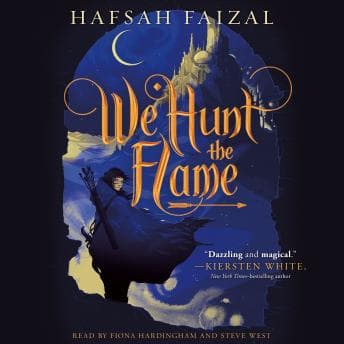

What does it mean to hide who you are so completely that even your victories feel like losses?
I was up at 2 AM, Diego curled on my chest like a furry heating pad, when Zafira's story hit me somewhere deep. This girl—disguising herself as a man just to hunt, just to feed her people, knowing that if anyone discovered the truth, everything she'd accomplished would mean nothing. And across the kingdom, Nasir, the Prince of Death, killing on command while burying every shred of compassion because showing softness would get him brutalized by his own father.
Abuela would have loved this one. The drama, the forbidden feelings, the ancient Arabia-inspired world with its sweeping deserts and cursed forests. She would've been clutching her rosary and asking me to translate the Arabic words—which, funny enough, brings me to my first real complaint.
The Mispronunciation That Made Me Wince
Look. Fiona Hardingham and Steve West are talented. They earned that Earphones Award for a reason. But the Arabic pronunciation? It's rough. Like, noticeably rough. Every time a name or term came up, I'd brace myself. For a book so lovingly rooted in Arab culture—written by a Muslim author who clearly poured her heritage into every detail—hearing those words mangled felt like a paper cut every few chapters. Small but persistent.
Does it ruin the experience? No. Did it pull me out of the immersion? Sometimes, yeah. If you're not familiar with Arabic, you probably won't notice. If you are, prepare to develop a slight eye twitch.
Zafira's Voice Found Me First
Hardingham does something really beautiful with Zafira. There's this quiet ferocity in her delivery—Zafira isn't loud about her strength, she just is strong, and Hardingham captures that restraint. The way her voice tightens when Zafira's identity is threatened, the way it softens when she thinks about her sister, the way it goes absolutely steel-cold when she's hunting. I believed her. I believed this girl could survive the Arz, this cursed forest that swallows people whole.
Steve West's Nasir, though... okay, this is where opinions split. Some listeners found his portrayal whiny, especially during Nasir's internal back-and-forth about whether he's too evil for redemption. And I get it—there are moments where Nasir's emotional turbulence feels like it's spinning in circles. "I'm bad." "Maybe I'm good?" "No, definitely bad." "But what if—" You know the type.
But here's the thing: I actually didn't hate it? Nasir is supposed to be a mess. He's been weaponized by his father since childhood. Of course he vacillates. West's delivery made me feel that instability in my bones. Was it frustrating sometimes? Sure. But it felt intentional, not accidental.
The Slow Burn That Actually Burned
This book is nearly 15 hours, and it takes its sweet time. The quest doesn't really kick into gear until you're a few hours in, and the romance between Zafira and Nasir? Slow. Burn. Like, "are they going to acknowledge their feelings before I finish this entire pot of coffee" slow.
But when the tension finally crests—when these two people who've been trained to hide everything start cracking open around each other—my heart. MY HEART. Sea of Monsters has that same reluctant-feelings energy, though with way more monsters and way less desert. The chemistry is chef's kiss. Enemies-to-something-more done right, where you genuinely believe these two would rather die than admit they care.
The world-building is lush, too. Ancient Arabia vibes, magic that's been stolen from the land, a sprawling mythology that feels both familiar and fresh. I got lost in it. That same immersive quality pulled me into Butterfly Room, though the mythology there goes in a completely different direction. The kind of lost where you look up and realize you've been designing the same logo for three hours because you forgot to actually work.
Who Should Get Lost in the Desert (And Who Should Stay Home)
This is a rainy Sunday book. Or a 2 AM insomnia book. Or an "I need to escape my entire life for 15 hours" book. If you love YA fantasy with romantic tension, found family dynamics, and protagonists who are hiding more than they're showing, you'll eat this up.
Skip it if mispronounced Arabic is a dealbreaker, or if you need your love interests to get their act together quickly. And if you hate slow pacing in fantasy? This might test your patience.
Diego Judged Me for Crying, But I Regret Nothing
We Hunt the Flame isn't flawless. The pacing drags in places, the Arabic pronunciation is genuinely frustrating, and Nasir's emotional spiraling might make you want to shake him through your earbuds. But the emotional core—two people learning to unmask themselves, to choose who they want to be instead of who they've been forced to become—that hit me right in the chest.
I ugly-cried at the end. Not the sobbing kind, but the quiet kind where your eyes just... leak. Diego looked at me like I was broken. I probably am.
Hafsah Faizal wrote something special here. And despite its flaws, the audiobook carries that specialness forward. Just maybe keep your expectations realistic about the pronunciation, and let yourself sink into the desert.