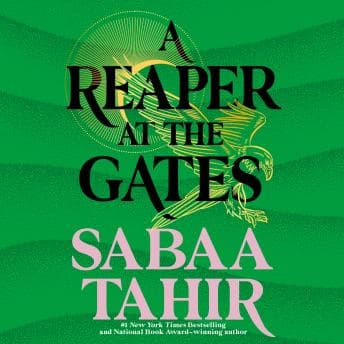

So Kevin and I had a rare Saturday where neither of us had on-call duties, and instead of being normal humans and going outside, I spent the entire afternoon on the couch with noise-canceling headphones finishing this 15-hour beast. He kept asking if I wanted dinner. I kept waving him off because Helene was having the worst day of her life - again - and I couldn't pause.
That pretty much sums up my relationship with Reaper at the Gates. It's not the best book in the Ember Quartet. But it's the one that made me forget to eat.
Helene Aquilla Deserved Better and I Will Die on This Hill
Look, Laia was my favorite in the first two books. But this installment? Helene's arc absolutely wrecked me. She's stuck between a violently unstable emperor and the Commandant - Keris Veturia, who is basically that VP at your company who smiles in meetings while quietly engineering everyone else's layoff. Helene's trying to protect her sister, hold the Empire together, and maintain her own moral compass while everything burns. It's the kind of impossible optimization problem that hits different when you've spent your own week triaging production fires with no good options.
Elias's storyline as Soul Catcher, on the other hand, felt like it was running on a different clock. He's wandering the land between living and dead, being cryptic, wrestling with his vow to give up everything - including Laia. It's necessary setup for book four, I get that. But where Helene's chapters had me white-knuckling through political betrayals and real stakes, Elias's sections sometimes felt like a loading screen between the parts I actually cared about.
Laia's arc splits the difference. She's hunting the Nightbringer, facing betrayals from people she trusted, and her chapters have genuine momentum. But Tahir is juggling three POVs plus a sprawling war narrative, and you can feel the seams. This is the classic "book three of four" problem - too much plate-spinning, not enough plates actually landing.
Four Narrators Walk Into a Recording Booth
The four-narrator setup (Fiona Hardingham, Katharine Lee McEwan, Maxwell Caulfield, Steve West) is ambitious, and mostly it works. Each POV character gets their own voice actor, so your brain can switch contexts without that "wait, who's talking now?" friction. It's like having separate log streams for each microservice - instant clarity on whose storyline you're in.
Here's the catch though: the volume levels between narrators are noticeably inconsistent. I had to adjust my phone volume multiple times during my listen, which is annoying on a lazy Saturday and would be genuinely awful on a packed 6AM Caltrain where you're trying to stay in that sweet spot between "can hear the book" and "not blasting audio to the person crammed next to you." It's the kind of production issue that shouldn't exist in 2024 (or whenever you're reading this), and it pulled me out of the story more than once.
The performances themselves are solid. Hardingham handles Helene's barely-contained desperation with real weight - you can hear the exhaustion in her voice during the political scenes. Steve West gives Elias a quieter, more internal quality that fits the Soul Catcher brooding, even if those sections dragged for me narratively. McEwan's Laia has the right mix of determination and vulnerability. Caulfield gets the smallest share of material but brings appropriate menace to what he's given.
None of them are Ray Porter. (Obviously. But I have to say it.) They're competent, sometimes excellent, but never quite transcendent.
The Third Book Tax
Every fantasy series pays it. The first book hooks you. The second book raises the stakes. The third book has to move all the pieces into position for the finale, and that means some storylines get stretched thinner than they should. Reaper at the Gates pays this tax honestly - the Helene material alone justifies the listen, and Tahir's willingness to go genuinely dark (content warning: there's violence here that earns its place but is not easy to sit through) keeps the stakes feeling real.
But if you loved the tight pacing of An Ember in the Ashes, be prepared for a slower burn. This is setup. Good setup, but setup. I hit the same wall with The Green Ember, actually - a third entry that's doing a lot of necessary work but rewards the patient listener more than the impatient one.
Perfect for: focused listening sessions, long drives. Skip for: 6AM commutes where you're half-conscious - too many threads to track while drowsy, and those volume jumps will jolt you awake at the wrong moments.
The Commit Message
The ROI on this audiobook is solid if you're already invested in the series. You're not going to start here - this is book three, and it assumes you know the world, the politics, the magic system. If you're already in, Helene's storyline alone is worth the 15 hours. If you bounced off books one or two, nothing here will bring you back.
I finished this wanting to immediately queue up A Sky Beyond the Storm, which is probably the highest compliment a penultimate book can earn. Even when it dragged, it dragged toward something I needed to see.
Kevin asked if I wanted to start it right then. I said yes. He sighed. He understands.