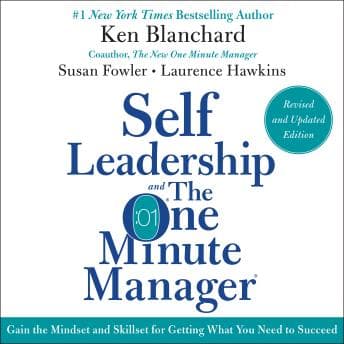

So last Tuesday I'm sitting in the Caltrain quiet car at 6:14 AM, running on maybe four hours of sleep after a deployment that went sideways, and I figured - you know what, let me try something short and practical instead of my usual 20-hour sci-fi binge. Self Leadership and the One Minute Manager clocked in at 2 hours 39 minutes. I finished it before we hit Mountain View. One commute. Done.
Here's the thing: I have a complicated relationship with Ken Blanchard books. The original One Minute Manager was one of the first business audiobooks I ever listened to, back when I was a baby engineer who didn't understand why my skip-level kept talking about "situational leadership." That book was fine. Short, parable-format, digestible. This one is basically The One Minute Manager but for managing yourself instead of other people. Same DNA, same format, same energy.
The Blog Post Problem (But Make It a Parable)
TL;DR: Could've been a blog post. Maybe two blog posts.
The entire framework boils down to three concepts: challenge assumed constraints, celebrate your points of power, and collaborate for success. That's it. The book wraps these in a story about Steve, an advertising exec who's about to get fired, learning from a mentor named Cayla. And look - the parable format works for what it is. Steve goes from victim mentality to proactive self-leader through a series of coffee-shop-style conversations. It's clean. It's structured. It's also extremely predictable from about minute fifteen onward.
What I actually found useful was the Situational Leadership II model applied to yourself - the idea that you cycle through different development levels (enthusiastic beginner, disillusioned learner, capable but cautious, self-reliant achiever) depending on the specific task, not your general competence. As someone who regularly context-switches between distributed systems debugging, code reviews, and cross-team architecture docs, this clicked for me. I'm a D4 self-reliant achiever at incident response but honestly a D2 disillusioned learner when it comes to writing design docs that don't read like incident reports. That framing is genuinely handy.
But the book takes 2.5 hours to deliver what could be a solid 20-minute conference talk. The Steve-and-Cayla dialogues pad everything out with "Wow, I never thought of it that way!" reactions that feel like they were written for a corporate training video. Which - fair, that's kind of Blanchard's whole brand.
Dan Woren Does His Job (Exactly His Job)
Dan Woren narrates this clean and professional. No complaints. Also no fireworks. He keeps Steve and Cayla distinct enough that you can follow the dialogue without confusion, which matters for the parable format. His pacing is steady - almost too steady for my taste, which is why I bumped it to 1.75x about ten minutes in and never looked back.
Compare this to, say, Ray Porter reading anything. (Yes, I'm biased. I know.) Porter would've given Steve some nervous energy, made Cayla's confidence feel warm instead of corporate. Woren delivers information. Porter delivers character. For a book this short and this framework-heavy, Woren's approach is fine. You're here for the content, not the performance.
No sound effects, no music, no production gimmicks. Straightforward narration. It's an Earphones Award winner doing clean, reliable work.
Who Gets ROI Here
Perfect for: train, gym. Skip for: deep work (it's not deep enough to warrant deep work).
If you're early in your career - first job, maybe second job, still figuring out how to advocate for yourself without being annoying about it - the assumed constraints framework is legitimately useful. Steve's habit of waiting for his boss to tell him exactly what to do, then complaining when the instructions aren't perfect? I've seen that pattern in junior engineers so many times. This book names it and gives you a mental model to break out of it.
If you've been in the game for a while, read any leadership books in the last decade, or sat through corporate L&D training on situational leadership - you've heard 90% of this before. The self-application angle is the only new-ish twist, and it's not enough to justify a credit.
Kevin (boyfriend, fellow audiobook nerd) actually listened to the original One Minute Manager years ago and said "it's a pamphlet disguised as a book." This revised edition is a pamphlet disguised as a slightly longer pamphlet. Think Like a Freak had the same pamphlet energy but at least dressed it up with enough counterintuitive data points to keep me guessing past Mountain View.
The Commute-Worthiness Calculation
The ROI on this audiobook is... mixed. At 2 hours 39 minutes, the time investment is tiny. The development-level self-assessment framework is a keeper - I've already caught myself using it twice this week when I noticed I was procrastinating on a task because I was in D2 mode and needed to ask for help instead of spiraling. That one insight paid for the listen.
But at credit price? When you could get a 15-hour book instead? Borrow this from your library app, listen at 1.75x, and you'll absorb everything useful in about 90 minutes between your front door and your desk. That's the move.