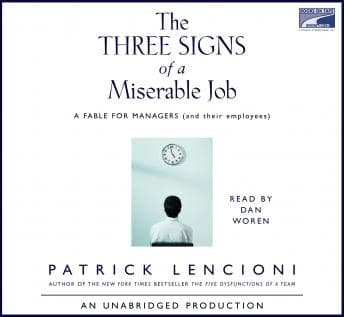

Look, I'm going to be honest with you - I'm tired of business books that take 45 minutes of insight and stretch them into 8 hours of filler. So when I saw this was only 5 hours, I actually felt something close to gratitude. Patrick Lencioni, you had me at brevity.
I finished this one while reorganizing my home office at 10 PM on a Tuesday - Jenny was already asleep, and I needed something that wouldn't put me to sleep but also wouldn't require me to take notes. This hit that sweet spot perfectly.
The Fable Format Actually Works (For Once)
Here's the thing about business fables: most of them are painfully contrived. Some executive learns life lessons from a wise janitor or whatever, and you're supposed to pretend that's profound. Lencioni's story about Brian Bailey - this retired CEO who ends up managing a pizza shop - could've gone that direction. But it doesn't feel preachy. It feels like watching someone actually work through a problem.
Brian's arc from high-powered executive to guy trying to motivate pizza delivery drivers hits different when you've spent years consulting for companies where C-suite folks have zero idea what frontline employees actually experience. I've sat in those boardrooms. I've watched executives talk about "employee engagement" like it's a dashboard metric instead of, you know, actual humans.
The three signs themselves - anonymity, irrelevance, and immeasurement - are so obvious once you hear them that you wonder why nobody packaged them this clearly before. My parents ran that dry cleaning business for decades, and looking back, they instinctively did two out of three. They knew every regular customer's name. They could see the direct impact of their work. The measurement piece? That was just survival math.
Dan Woren Gets the Job Done
Dan Woren's narration is... fine. I don't mean that as an insult. He's clear, professional, doesn't get in the way of the content. For a business fable, that's actually what you want. I'm not looking for dramatic vocal performances when someone's explaining management theory. He reads it like a competent professional delivering a presentation - which, for this genre, is appropriate.
No weird pronunciation issues. No pacing problems. At 1.5x speed (my compromise between efficiency and actually retaining information), everything tracked smoothly. Sometimes the best thing a narrator can do is disappear, and Woren does that well.
Where It Gets Real
The investment banker subplot - where Brian tries to convince this finance guy that job satisfaction actually matters - that's where Lencioni earns his keep. Because I've had that conversation. Multiple times. With people who genuinely believe that compensation is the only lever that matters for retention. And they're wrong, but they're wrong in ways that are hard to articulate without sounding like you're running a feelings workshop.
Lencioni gives you the language. That's the real value here.
That same instinct - giving people a framework for things they already feel but can't name - is what makes Daring Greatly worth the time too, though Brown comes at the management question from a completely different angle.The pizza shop stuff is where the rubber meets the road. Watching Brian apply these concepts to minimum wage workers - not just executives - shows that this isn't just another framework for people who already have good jobs. It's applicable to anyone managing anyone.
(My parents would've called this "treating people like people." They didn't need a business book for that. But apparently a lot of managers do.)
Who Should Listen (And Who Should Skip)
If you're a manager who's ever wondered why your team seems checked out despite decent pay and reasonable hours, this is your book. Skip to the model explanation if you're impatient - Lencioni front-loads the story, back-loads the framework summary.
If you're an employee trying to diagnose why your job feels soul-crushing even though it looks good on paper, this will give you vocabulary for what's wrong. Whether that helps you fix it or just articulate your resignation letter better - that's on you.
If you've already read Lencioni's other stuff and liked it, you know what you're getting. Same format, different topic.
Five Dysfunctions of a Team is the one I'd start with if you haven't read him before - same fable structure, and honestly the boardroom dynamics hit closer to what I saw in consulting than the pizza shop setting does.If you hate business fables and just want bullet points, this isn't going to convert you. The story is the delivery mechanism, and you can't skip it.
Executive Summary
Bottom line: this is what good business books should be. Tight, practical, applicable across organizational levels. At 5 hours, Lencioni respects your time - which, given the topic of job misery, feels appropriately self-aware.
I've recommended worse books to clients who paid me a lot of money for advice. This one's worth the listen. The core framework is worth the listen. The other 4 hours? Also worth it, which is rare.
Jenny would say I'm being generous. Jenny hasn't sat through as many 12-hour business audiobooks as I have. Context matters.