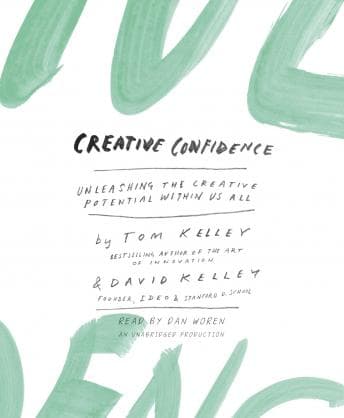

What if the thing holding you back from being creative is literally just... believing you're not creative?
I know, I know. Sounds like something you'd see on a motivational poster next to a stock photo of a mountain. But here's the thing—when the guys who built IDEO and Stanford's d.school say it, they've got the receipts. And after 7 hours on the Caltrain with this one, I'm actually kind of convinced.
The Case Study Parade (In a Good Way)
Look, I'll be honest. This book is basically a greatest hits compilation of IDEO projects and d.school success stories. The Kelley brothers have worked with everyone from Apple to healthcare startups, and they're not shy about sharing. Normally this would annoy me—the business book equivalent of someone showing you vacation photos for three hours—but the examples actually land.
They break down how a nurse redesigned hospital procedures, how engineers learned to think like designers, how regular people who swore they "weren't creative" ended up innovating in ways that mattered. It's less "here's our genius" and more "here's proof that you're not broken." The ROI on this audiobook is basically permission to try stuff and fail. Which, as someone who debugs distributed systems for a living, I can tell you is underrated.
The core concept is "creative confidence"—this idea that creativity isn't some mystical gift but a muscle you build through practice and by pushing past fear. They call out how school and work systematically beat the creativity out of us, and honestly? I felt seen. I spent years thinking I was just "the technical one" while my designer friends got to be "the creative ones." Turns out that's garbage.
Dan Woren: Relaxed Dad Energy at the Mic
So Dan Woren. He's got this warm, chill delivery that AudioFile Magazine described as "totally connected to the material," and yeah, I get it. He sounds like a really smart uncle explaining something interesting at Thanksgiving. Clear, engaged, zero drama.
Here's the polarizing part though—some people find him boring. Like, sleep-inducing boring. One review literally said "the narrator could put me to sleep." And I can see it? At 6 AM on a packed train, there were moments where his even-keeled delivery almost lulled me into missing my stop. But I bumped it to 1.5x (my standard) and it was perfect. The pacing issue isn't Woren—it's that business books rarely need the slow, contemplative treatment. Speed it up and you're golden.
He doesn't do voices or dramatic pauses. This isn't a thriller. It's a business book with heart, and Woren treats it that way. Could've been a blog post? Nah, actually. There's too much here, and Woren keeps it from feeling like a lecture.
Where It Drags (And Where It Flies)
Okay, real talk. Some sections feel repetitive. By the fourth or fifth "here's another person who thought they weren't creative but then did creative things" example, you get the pattern. The Kelleys are making the same point from different angles, which is effective for retention but occasionally tedious. Kitchen Confidential has that same repetitive-but-effective rhythm—Bourdain circles back to the same restaurant war stories from different angles until the lessons stick.
But then they'll hit you with something genuinely useful—like their framework for rapid prototyping, or how to structure brainstorming sessions that don't suck, or why "failing fast" actually works in practice. The practical stuff is solid. I've already started applying some of it to how my team approaches problem-solving. (Don't tell my manager I learned leadership skills from an audiobook.)
The book also connects creativity to meaning and purpose in a way that doesn't feel cheesy. They talk about using design thinking for social good, for personal fulfillment, for building things that matter. And coming from two guys who could easily coast on corporate consulting fees, it feels genuine.
Best Use Cases (and When to Skip)
I finished this in about 3 commutes, and it was solid company. Not the kind of book that demands your full attention, which is actually a feature when you're sardined between other commuters. You can zone out for a minute, tune back in, and not feel lost.
Queue this up if: you're someone who thinks creativity is for "other people"—artists, designers, people who wear interesting scarves. It's basically therapy for imposter syndrome, but with case studies instead of breathing exercises. Skip it if: you're already bought in on design thinking and just want tactical frameworks. The Kelleys spend more time on the "why" than the "how."
Would I listen again? Probably not cover to cover. But I'd revisit specific sections when I need a reminder that trying new things won't kill me. Which, given my job, is more often than I'd like to admit.