
When's the last time you actually sat with your own thoughts for five minutes without reaching for your phone?
I couldn't answer that honestly, which is probably why this book hit different than I expected. I was prepping for a client workshop at midnight - spreadsheets open, AirPods in, brain running at its usual 14-tab speed - and figured a 3-hour-20-minute listen on silence would be the perfect background filler before bed. Efficient, right? Knock it out in under two hours at 2x.
Except about twenty minutes in, I actually slowed down to 1.25x. I never do that. Jenny noticed and asked if I was feeling okay.
The Anti-Business Book That Every Business Person Needs
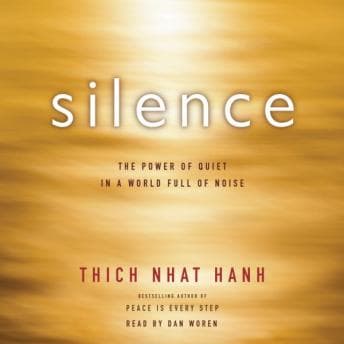
Here's the thing about Thich Nhat Hanh - the late Vietnamese Zen master who spent decades teaching mindfulness long before it became a Silicon Valley productivity hack. He doesn't pitch you a framework. There's no 4-step method, no acronym, no case study from Google. Silence is essentially a collection of short, meditative passages about learning to stop running. Stop consuming. Stop filling every gap with noise, input, optimization.
And I'm sitting here - a guy who literally listens at 2x because "time is money" - getting called out by a Buddhist monk. The irony wasn't lost on me.
The book's core argument is deceptively simple: the noise isn't just external. It's the constant internal radio - what Thich Nhat Hanh calls "Radio NST" (Non-Stop Thinking). The planning, the worrying, the replaying of conversations. He argues that silence isn't the absence of sound but the presence of attention. That's the whole book, really. But unlike most self-help authors who'd stretch that into 12 hours with anecdotes about their morning routine, he says it in 3 hours and 20 minutes.
Finally, a business book - okay, it's not a business book, but stay with me - that respects your time.
What My Parents Already Knew (Without the Buddhism)
Some of the breathing exercises Thich Nhat Hanh walks through - conscious breathing in, conscious breathing out, awareness of your body while doing mundane tasks - this is what my mom did every morning before opening the shop at 6 AM. She'd sit at the kitchen table with her tea for exactly ten minutes. No prayer, no meditation app, no intention-setting. Just sitting. My dad thought it was a waste of time. I inherited his opinion.
I'm reconsidering.
The practical guidance here is genuinely simple to implement. Not easy - simple. There's a difference. Thich Nhat Hanh suggests things like taking three conscious breaths before answering the phone, or walking between meetings with full awareness of each step. No special equipment. No retreat in Bali. Just... paying attention. This is what my parents did instinctively. Now it has a TED talk.
But I'll be honest - some listeners describe this book as more "a series of sound bites" than a structured narrative, and they're not wrong. It reads like collected wisdom rather than a single argument building to a crescendo. If you need a throughline with rising tension and a big payoff at chapter 9, this isn't that. I had a similar experience with Torment — a book that also resists the tidy narrative arc and just keeps circling the same wound from different angles until something finally lands. It's more like... someone wise sitting across from you, saying the same essential truth seventeen different ways until one version finally breaks through your defenses.
Dan Woren Made a Smart Choice
The narration question here is interesting because the wrong voice would've destroyed this. Dan Woren goes conversational and unhurried - no dramatic inflection, no "inspirational" voice that sounds like a yoga instructor selling you essential oils. He reads it straight, almost like he's relaying advice from a friend. One listener described it as "spiritual arms wrapping me up," which - okay, that's a bit much for my taste, but I get the sentiment. Woren respects the text without performing it. For material this spare and quiet, that restraint is exactly right.
No sound effects, no music, no production tricks. Just a guy reading wise words clearly. Sometimes that's enough.
Who Gets the ROI
If you're a founder running on cortisol and cold brew, this might be the intervention you didn't ask for. If you're already deep into mindfulness practice, this will feel like review - pleasant but not new. If you need actionable business frameworks, skip it. But if you're the type who fills every waking moment with podcasts, audiobooks, Slack notifications, and productivity content (hi, it me), this book is a mirror you didn't want to look into.
At 3 hours and 20 minutes, even at normal speed, you can finish it in a long evening. The commitment is minimal. The discomfort it causes your ego? Less so.
The Consulting Rate for This Advice
Bottom line: This book won't teach you how to scale a startup or optimize your funnel. It'll teach you how to stop for five seconds and notice you're alive. I gave it to a founder last week who hasn't slept properly in months. She texted me at 6 AM saying she'd slept through the night for the first time in weeks. Correlation isn't causation, but still.
My 2.0x speed couldn't save this one - because it didn't need saving. It needed slowing down. Jenny would say I'm being soft. Jenny is right.