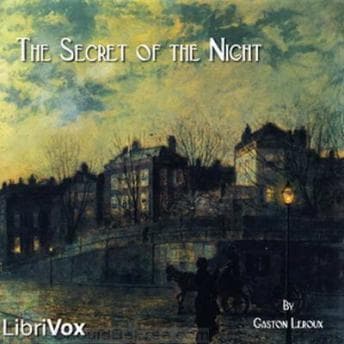

Gaston Leroux deserves better than this.
Look, I'll be upfront: I came to Secret of the Night because I'm a Leroux completist in the making. The man wrote The Phantom of the Opera — one of the greatest Gothic horror-adjacent novels ever penned — and then apparently decided he'd rather write detective fiction featuring a baby-faced journalist named Rouletabille who solves crimes through pure deductive reasoning. And honestly? The Rouletabille books are underrated little puzzles. This one drops our boy into Czarist Russia, surrounded by Nihilists, political intrigue, and enough Russian names to make your head spin like you're reading Dostoevsky after three espressos.
I was shelving returns at the library on a slow Thursday afternoon with this piped through my earbuds, and within the first hour I realized that was a tactical error. This is not a background listen. Not even close.
Rouletabille in Russia Should Be More Fun Than This
The premise is genuinely promising. Rouletabille travels to St. Petersburg to investigate threats against a Russian general, and the political landscape — Czarist loyalists versus Nihilist revolutionaries — gives the mystery real stakes. Leroux was clearly drawing from the political anxieties of his era, and there's a density to the plotting that reminds me of Wilkie Collins at his most ambitious. The deductive method Rouletabille uses is interesting too: instead of eliminating the impossible like Holmes, he catalogs known facts and strips away everything that merely looks relevant but isn't proven. It's a subtle but meaningful difference in approach, and Leroux builds some clever misdirection around it.
But here's the problem. The plot is convoluted. Not in the satisfying "oh, I see what you did there" way — more in the "wait, who just walked into the room?" way. There are a LOT of Russian names and characters cycling through scenes, and keeping track of who's aligned with whom requires the kind of focused attention I usually reserve for Shirley Jackson's nested psychological games. Except Jackson rewards that attention. Leroux... mostly just keeps adding characters.
The Narrator Problem (And It's a Big One)
I need to talk about Don W. Jenkins, because the narration nearly sinks this entire experience. Jenkins reads at an even, steady pace — I'll give him that. He's not rushing, he's not dragging. The tempo is fine. But tempo alone doesn't make a performance.
Every character sounds the same. Every single one. In a book packed with Russian generals, their wives, servants, Nihilist conspirators, and a French journalist protagonist — you need vocal differentiation. You're begging for it. Even small things — a slightly clipped delivery for Rouletabille's confident deductions versus a heavier, slower cadence for the Russian military men — would've gone a long way. Instead, it's one flat vocal register for nine hours. I lost track of who was speaking in dialogue-heavy scenes multiple times. Had to rewind. Had to guess from context. That kind of guesswork fatigue is exactly what tanked my experience with Clock Strikes Thirteen too — when a narrator sleepwalks through a dense cast, the whole mystery collapses into noise.
The narrator doesn't commit. And for me, that's the line between an audiobook performance and someone just... reading words aloud. I've said it on the podcast a hundred times: audiobook narrators are actors. Jenkins doesn't seem to know that, or if he does, he chose not to engage with it here. The Russian names — which are already challenging for an English-language listener — get no special care either. They blur together, which compounds the character confusion exponentially.
I'll be blunt: if you're considering this audiobook specifically because you want the audio experience, this version will frustrate you.
So Who Is This Actually For?
If you're a Leroux fan who's already read The Mystery of the Yellow Room (the first Rouletabille novel, and the better entry point), and you want to continue the series — there's enough here to justify your time. The historical setting is interesting, and Leroux's structural approach to mystery-building is distinct enough from his contemporaries that it's worth studying. But I'd honestly recommend reading the text over listening to this particular recording. Or at minimum, listen at 1.25x speed to keep momentum, because at normal pace, the flat narration lets the convoluted plot drag you under.
If you're new to Rouletabille, start with Yellow Room. If you're new to Leroux entirely, start with Phantom. This is deep-catalog territory for the already converted.
Shelving This One in the Back Stacks
Leroux's source material has its charms — the man understood how to construct a puzzle, even when he overstuffed it with moving pieces. But this audiobook version doesn't serve the material well. A better narrator could've elevated this into something genuinely engaging. Instead, it's nine hours of fighting to keep characters straight while a monotone voice reads Russian names at you. Shirley (my cat) was unimpressed. For once, I agreed with her.