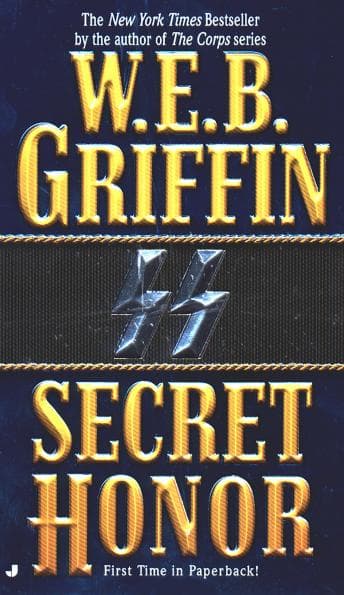

Look, I need to talk about something that drives me absolutely nuts in military thrillers: the assumption that readers (or listeners) can't handle complexity, so the author dumbs everything down. W.E.B. Griffin does the exact opposite with Secret Honor, and I'm here for it. Nineteen hours of espionage that trusts you to keep up with dual-continent plotting, overlapping intelligence agencies, and enough codenames to fill a phonebook. This is not a casual listen. This is a commitment.
I started this one during a stretch of four consecutive night shifts, which - if you know anything about 12-hour overnights - means my brain was operating on a cocktail of caffeine and sheer stubbornness. And yet Griffin's web of SS officers, OSS agents, Argentine politics, and the Wolf's Lair assassination plotting kept me tracking every thread. That says something.
The Part Where I Yell About Intelligence Agencies Actually Acting Like Intelligence Agencies
Griffin clearly did his homework on wartime intelligence operations, and it shows. The rivalry between the SS and the Abwehr isn't just window dressing - it's baked into the plot mechanics. The bureaucratic infighting, the way information gets siloed and weaponized between agencies, the paranoia - it all rings true in that ugly, institutional way that anyone who's worked in a large organization recognizes. I kept thinking about how Harvester taps into that same institutional rot - different setting, but that identical sense of systems failing people from the inside out. (Hospitals have their own version of this. Trust me. The turf wars between departments at 2 AM would make the OSS blush.)
Cletus Frade as a protagonist is interesting because he's not your typical action hero. He's a guy navigating impossible loyalties - branded a rogue by his own agency while trying to protect assets on two continents. Griffin writes him with enough swagger to keep things entertaining but enough real vulnerability that you don't roll your eyes. The dynamic between Frade and the German general's son, codenamed Galahad, has genuine tension because you understand what both men stand to lose. Their fates are tangled in ways that feel organic, not manufactured.
But here's where some listeners are going to struggle: Griffin loves his details. Loves them. There are stretches where the political and military context gets laid out with the precision of a briefing document, and if you're looking for nonstop action, you're going to be checking your rearview mirror wondering when something's going to blow up. It doesn't drag exactly, but it breathes. Slow and deliberate, like a long exhale between crises.
Scott Brick in a Dark Bar at Midnight
Scott Brick narrates this thing like he's telling you classified information across a dimly lit table, and honestly? That energy works. His delivery has this steady, authoritative cadence that makes even the exposition-heavy sections feel like you're being let in on something important. The AudioFile Earphones Award wasn't unearned.
Where he stumbles - and this is a real issue for the audio format - is with the italicized thoughts. In print, you see the italics, your brain shifts gears, you know you're inside a character's head. In audio, that transition gets muddy. There were at least a few moments during my drives home where I rewound because I genuinely couldn't tell if a character was speaking out loud or thinking something. For a book where internal calculations and deceptions are critical to the plot, that confusion is more than cosmetic. It's the difference between understanding a character's strategy and missing it entirely.
That said, Brick's handling of the conversational scenes - especially the back-and-forth between rival intelligence officers - has real bite to it. There's a dry, satirical edge to some of those exchanges that Brick delivers with just enough smirk in his voice. You can hear the contempt these men have for each other's agencies even when they're being polite about it.
Who Survives This 19-Hour Mission
This is for the patient listener. The person who wants their WWII fiction to feel like a chess match, not a firefight. If you've read the earlier Honor Bound books, you'll get more out of the character relationships - this is book three, and Griffin assumes some familiarity. You can jump in cold, but you'll be playing catch-up for the first few hours.
Skip if: you need action every chapter, you're not willing to track multiple plot threads across continents, or you're looking for something light for a quick errand run. This is a 45-minutes-each-way, multiple-days kind of listen.
Shift Change
Carlos asked why I kept muttering "don't trust the OSS" in my sleep. I blamed work stress. But really it was Frade's situation getting under my skin in that way only a good slow-burn espionage story can. Griffin writes with the confidence of someone who knows this world inside and out, and even when the pacing tests your patience, the payoff in plot complexity is worth it. The italicized-thoughts issue in audio is a real ding - it pulls you out of a story that demands your full attention. But Brick's dark-bar delivery carries most of the weight.
Night shift approved. Bring coffee.