
W.E.B. Griffin wrote the kind of military fiction that makes you realize most thrillers are just playing dress-up.
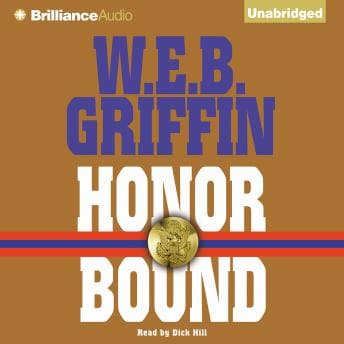
I started Honor Bound during a Saturday morning walk along the lakefront with Denise, and by the time we got home, I told her I needed to keep going. She gave me that look — the one that says "you're about to disappear into headphones for the rest of the weekend." She wasn't wrong. Twenty-one hours and forty-three minutes later, I emerged blinking like a man who'd been living in 1942 Buenos Aires.
Griffin Builds His Spy Novel Like a History Lecture You Actually Want to Attend
Here's what Griffin does that most espionage writers don't bother with: he makes the logistics interesting. Cletus Frade isn't just a Marine aviator dropped into Argentina — he's a Guadalcanal veteran with a dead father's legacy tangled up in Argentine politics, and Griffin spends real time building the web of why that matters. The OSS mission to sabotage German resupply ships is the engine, sure, but the fuel is everything around it: the Argentine government's precarious neutrality, the German expatriate community in Buenos Aires operating with near-impunity, the local security services playing every side against the middle.
This reminds me of what Hemingway said about writing — that the dignity of movement of an iceberg is due to only one-eighth of it being above water. Griffin clearly did his homework on wartime South America, and you feel the other seven-eighths beneath every scene. The supposedly neutral Buenos Aires he constructs isn't a backdrop — it's a pressure cooker where Allied agents, German operatives, collaborators, and Argentine power brokers are all circling each other in drawing rooms and back alleys. The slow accumulation of detail is the point. My students would hate this. I love it.
But let's be honest about what that means for pacing. This is a slow book. If you're expecting Jason Bourne in Argentina, Griffin will test your patience. He's building something more like a Le Carré novel set in the military — procedural, layered, and confident that the reader (or listener) will stick around for the payoff. I did. But around hour twelve, during a late-night grading session, I caught myself drifting. Not because the writing failed, but because Griffin sometimes lingers on operational details and character introductions in a way that assumes you're as fascinated by military hierarchy as he is. (Sometimes I am. Sometimes I'm also grading sophomore essays on The Great Gatsby and my attention budget is spent.)
Dick Hill Narrates Like a Briefing Officer — And That's Both the Strength and the Problem
Dick Hill's narration is precise. Clean. Military-crisp. And for about seventy percent of this book, that's exactly right. Griffin's prose is straightforward, workmanlike, built for clarity rather than poetry — the prose deserves to be savored at the sentence level, but it's savored for its efficiency, not its beauty. Hill matches that energy well. His pacing is steady, his diction is sharp, and he handles the military terminology and Spanish place names without stumbling.
Here's the catch: Hill differentiates characters through subtle tone shifts rather than distinct voices, and in a book with this many players — Frade, Pelosi, Ettinger, the enigmatic Colonel Loman, plus a rotating cast of Argentine and German figures — "subtle" sometimes means "I'm not sure who's talking." There's a flatness that creeps in during dialogue-heavy sections. When Frade is navigating a tense exchange with an Argentine intelligence officer, you want to feel the knife-edge of that conversation. Hill delivers the words accurately but doesn't always deliver the tension underneath them. It's like watching a technically perfect musician play jazz without swing.
I listened at 1.0x — because the author chose those words — and at that speed, Hill's measured delivery works better than I think it would at 1.25x. Speeding him up would only amplify the monotone stretches.
Who This Is Really For (And Who Should Walk Away)
If you're a Griffin reader, you already know what you're getting and you probably already own this. If you're new to Griffin, this is a solid entry point — it's the first book in the Honor Bound series, and it establishes its world with the kind of patient authority that rewards commitment. Fans of Alan Furst's atmospheric WWII espionage or the procedural detail of Tom Clancy's earlier work will find a lot to appreciate here.
But if you need constant action beats to stay engaged, or if you want a narrator who performs rather than reads, this one will frustrate you. This is a focused-listening audiobook. I wouldn't recommend it for background noise or a distracted commute. It wants your attention, and it's long enough that losing the thread means rewinding twenty minutes.
Worth Pausing the Faculty Meeting For — Mostly
Griffin's historical chops carry this book through its slower stretches, and Hill's narration — while not electric — is professional enough to serve the material. It's a book that respects the intelligence of its audience, which is something I always appreciate, even when it occasionally tests my patience. The Buenos Aires setting alone sets it apart from the crowded field of WWII fiction that never leaves Western Europe. This is why we still read the classics of genre fiction — because the best ones teach you something about history while telling you a story worth hearing. I didn't get quite that same historical payoff from Harvester, which I reviewed a while back and found more style than substance beneath the surface.