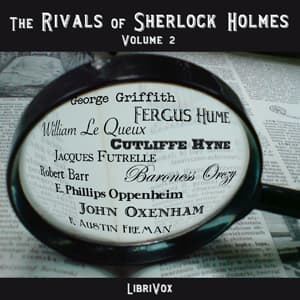

Holmes had rivals. Real ones. And the Victorians knew it.
I've spent years on "The Witching Hour" arguing that the Golden Age of detective fiction wasn't just Doyle's playground. But listening to this anthology in the dark of my apartment—Shirley curled on my chest, rain against the windows—I finally felt that argument in my bones. These stories aren't footnotes to Holmes. They're the genre finding its legs, stumbling beautifully, sometimes outpacing the master himself.
The Old Man in the Corner Changes Everything
Baroness Orczy's contributions here stopped me cold. Her armchair detective—an unnamed old man who solves crimes while obsessively tying and untying knots in a piece of string—predates so many tropes we take for granted. He never leaves his corner of an A.B.C. tea shop. He just thinks. And his solutions carry this unsettling moral ambiguity that Doyle rarely touched. Criminals sometimes go free. Justice isn't always served. The old man seems almost amused by this.
Shirley Jackson walked so Orczy could run, honestly. The psychological unease in these stories—the sense that the detective might not be entirely on the side of angels—that's horror-adjacent territory. That same moral ambiguity drives Pieces of Her, where the detective work uncovers truths that maybe should've stayed buried. My podcast listeners are going to eat this up.
LibriVox Roulette (You Know What I Mean)
Here's where I have to be honest: this is a LibriVox production with multiple volunteer narrators, and the quality varies. Some readers commit. They understand that Victorian detective fiction requires a certain theatrical restraint—not melodrama, but precision. Others read like they're getting through a grocery list.
I don't have specifics on which narrator handles which story because the research came up blank on individual performances. What I can tell you is that anthology audiobooks from volunteer projects are always a gamble. You might get a reader who makes Arthur Morrison's Martin Hewitt feel like a flesh-and-blood investigator. You might get someone who turns L.T. Meade's medical mysteries into monotone exercises.
At ten and a half hours, there's enough variety that the weaker readings don't sink the ship. But this isn't a polished Audible production. Adjust expectations accordingly.
What These Stories Actually Do
The twelve tales here span a fascinating range. You've got scientific detection before forensics was cool. You've got lady investigators in an era that pretended women couldn't think critically. You've got detectives who are doctors, journalists, insurance investigators—people working angles Holmes never touched because he was too busy being brilliant in his sitting room. Murder in an Irish Village takes that same approach with a small-town setting where everyone's an amateur investigator whether they want to be or not.
The pacing is Victorian, which means patient. These stories breathe. They set scenes. They let you marinate in gaslit London and country estates before the puzzle pieces start clicking. If you need constant action, you'll struggle. If you appreciate the slow build of dread and deduction—the way a good mystery should feel like walls closing in—you're home.
One thing that struck me: the Ernest Bramah story is missing due to copyright issues. His Max Carrados—a blind detective—would've added another dimension to the collection. It's a notable gap, though the summary acknowledges it upfront.
Who Should Wander Into This Corner
You want this if: you're a mystery completist tired of Holmes pastiches, you appreciate detective fiction as a genre with actual history, or you're curious about the women writers who shaped crime fiction before Agatha Christie got all the credit.
Skip if: you need professional narration to stay engaged, Victorian prose makes you sleepy, or you're looking for something to half-listen to during workouts. This requires attention.
I listened during a 2 AM insomnia spiral—the kind where my brain won't shut off and I need something absorbing but not visually demanding. Perfect fit. The episodic structure means you can stop between stories without losing threads.
The Witching Hour's Final Word
This collection understands something important: the detective story didn't spring fully formed from Doyle's head. It was a conversation. Orczy, Morrison, Meade, and the rest were arguing back, pushing boundaries, asking what detection could be beyond one eccentric genius and his loyal doctor.
The audio quality is what it is—free, public domain, volunteer-produced. But the stories themselves? Mystery that actually respects the genre's roots. Worth your time if you're willing to meet it halfway.