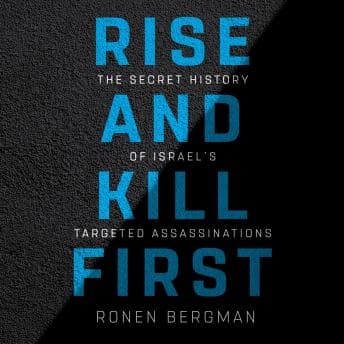

Twenty-six hours. That's longer than most of my flights to the sandbox ever were, and I spent every minute of this one glued to my truck's speakers.
Let me cut to the chase: Ronen Bergman's Rise and Kill First is the most comprehensive operational history of targeted killing I've ever encountered. And I've read the classified briefings. This book goes places those documents don't.
The Intel That Actually Checks Out
Here's what separates Bergman from the armchair analysts who write most books about intelligence operations—he did the legwork. We're talking interviews with prime ministers, Mossad directors, Shin Bet operatives. The guy got Sharon on record. Netanyahu. Barak. These aren't anonymous sources hiding behind "a senior official familiar with the matter." These are the principals.
That kind of source discipline is why I also respected Changes in the Land; different battlefield entirely, but the same insistence on tracing consequences instead of waving at them.I've seen this scenario play out in real life—the gap between what the public thinks special operations look like versus the messy, morally complicated reality. Bergman gets it right. The planning. The second-guessing. The operations that go sideways because some kid on a bicycle shows up at the wrong moment. The weight that stays with operators decades later.
What really got me was the evolution of doctrine. Israel didn't just wake up one day and decide targeted assassination was acceptable. There's a throughline from 1948 to the present—the Talmudic justification in the title, sure, but also the institutional learning, the failures that shaped policy, the unintended consequences that created new enemies. That's the part most books skip. Bergman doesn't.
Rob Shapiro Keeps You Locked In
Twenty-six hours is a commitment. I've abandoned books at hour three because the narrator made me want to drive into a ditch. Shapiro? He's steady. Professional. Doesn't try to be dramatic when the material is already dramatic enough.
His pronunciation of Hebrew names and places is consistent—that matters when you're tracking dozens of operations across seven decades. And his pacing is right. Not rushed, not dragging. Just clear delivery that lets the material breathe.
Shapiro brought that same no-nonsense control to Oblivion, which told me this wasn't a lucky draw—it was a professional doing the job right.I listened at 1.25x (because life's too short for slow narrators) and it worked perfectly. The production is clean—no weird audio artifacts, no background noise. Just Shapiro and the story.
Where It Gets Heavy
Look, I'm not going to pretend this is easy listening. There are operations in here that worked. There are operations that killed the wrong people. There are moments where you understand exactly why Israel made the calls they made, and moments where you sit in your truck in the driveway for an extra ten minutes because you need to process what you just heard.
The ethical questions aren't resolved. Bergman doesn't try to resolve them. He presents the decisions, the context, the consequences, and lets you sit with the weight of it. That's honest journalism.
I've been in rooms where these kinds of decisions get made. Different country, different targets, same fundamental questions. Who lives. Who dies. What's the threshold. What's the blowback. Bergman captures that tension better than any civilian author I've read.
Who This Is For (And Who Should Stand Down)
If you want to understand how a nation-state institutionalizes targeted killing—the legal frameworks, the operational evolution, the human cost on both sides—this is the definitive work. Period. But if you're looking for a quick thriller or can't commit to the runtime, stand down. This one demands your full attention.
The Debrief
Is it dense? Yeah. Twenty-six hours dense. But it's dense because the subject demands it, not because Bergman is padding word count. Every operation he covers connects to the larger strategic picture.
My one note—and it's minor—is that the sheer volume of names and operations can blur together on first listen. I found myself rewinding occasionally to track who was who in a particular operation. That's not a flaw in the book; it's just the nature of covering seventy years of covert action.
Ranger slept through most of this one, which is probably for the best. Some of these operations would give him nightmares.
Mission accomplished, Bergman. This is how you write intelligence history.