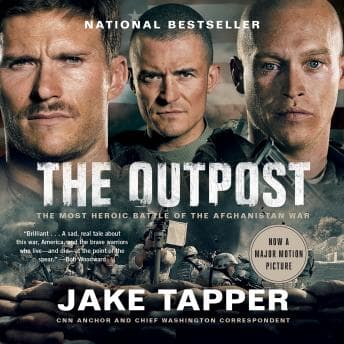
"There was no reason for the troops at Keating to have been there in the first place."
That line from the Pentagon review hit me somewhere around hour sixteen, and I had to pull my truck over. Not because I didn't already know it - anyone who served in those years knew the strategic lunacy of some of our outpost placements. But hearing it stated so plainly, after Tapper had spent fifteen hours introducing you to every single soldier who lived and died at that godforsaken position in Nuristan Province, surrounded on all sides by mountains that gave the enemy perfect firing positions - it lands like a gut punch.
I listened to most of this on a drive from Austin to a client site in El Paso. Eight hours out, eight hours back. Ranger in the back seat. And I'm not ashamed to say that dog saw me wipe my eyes more than once on I-10.
Fifty-Three Men in a Fishbowl
Let me cut to the chase. Tapper did something here that most civilian journalists can't pull off: he wrote a military book that respects the men without turning them into cardboard action figures. COP Keating sat at the bottom of three steep mountains along the Kamdesh road, right next to the convergence of two rivers. If you drew up the worst possible defensive position in a tactics course at Leavenworth, you'd get laughed out of the room - and yet there it was, occupied by American soldiers for years.
What Tapper gets right is the slow buildup. This isn't just a battle book. He traces the outpost from its establishment, through multiple unit rotations, through the political and military decisions that kept it open long past any rational justification. You get to know the commanders who argued for closing it and were overruled. You get to know the soldiers who rotated through - their backgrounds, their families, their quirks. Specialist Stephan Mace talking about his daughter. Staff Sergeant Clint Romesha's stubborn refusal to accept the tactical reality as permanent. These aren't characters in a story. They were real men, and Tapper clearly interviewed extensively to get them right.
The author clearly did their homework. When he describes the terrain, the distances, the weapons systems, the radio procedures - I wasn't grinding my teeth. That matters. I've thrown books across the room (well, ripped out earbuds) for getting basic stuff wrong. Tapper doesn't call magazines clips. I gave History of the Decline and Fall of the Roman Empire Vol. V a lot less charity when Gibbon's translators muddied the command structures of the late legions - competence with institutional hierarchy is a baseline requirement for me, whether we're talking Nuristan or Constantinople. He understands the chain of command, the friction between company-level decisions and brigade-level politics. The way he lays out the counterinsurgency strategy debates between population-centric COIN and the realities on the ground in eastern Afghanistan - that's stuff I lived through from a different vantage point, and he nails the frustration.
When October 3rd Finally Arrives
The battle itself is about as intense as audiobook listening gets. Nearly 400 fighters hitting a position held by 53 Americans at dawn. Tapper reconstructs it almost minute by minute - the initial volleys, the breach of the perimeter, the desperate counterattacks. He doesn't sanitize the injuries. Men burned. Men shot multiple times and kept fighting. The descriptions are graphic and they should be, because sanitizing combat is its own kind of disrespect.
But here's my one honest criticism: the 22.5-hour runtime is a commitment, and there are stretches in the middle third where the detail gets dense. Unit rotations, personnel changes, meetings at Bagram - Tapper is building context, and I appreciate the thoroughness, but some listeners are going to feel it dragging. I've seen this scenario play out in real life, where the staff briefing goes forty minutes too long before you get to the operations order. Necessary? Maybe. Painful? Sometimes.
Rob Shapiro's narration is solid throughout. He doesn't try to do theatrical voices for different soldiers, which is the right call - this isn't fiction and it would've felt cheap. What he does well is maintain a steady, respectful tone that knows when to tighten up during the combat sequences. His pacing during the October 3rd attack kept my heart rate elevated for a good two hours straight. No small feat for a single narrator carrying 22 hours of material.
The Part That Stays With You
The families. Tapper doesn't just cover the battle - he follows the notification teams to the doorsteps. The Gold Star families, the wives and parents and children who got that knock. Those sections are where this book becomes something bigger than a military history. It becomes an accounting of what we asked these families to pay, and whether anyone at the Pentagon was keeping the ledger honestly.
I've been on both sides of that equation. I've written condolence letters and I've sat with families. Tapper handles it with the gravity it demands.
Worth your time? Here's the debrief: if you care about what actually happened in Afghanistan - not the political talking points, but the ground truth of what American soldiers endured because of strategic decisions made far above their pay grade - this is essential listening. It's long. It's detailed. Parts of it will make you angry in ways that don't have easy outlets.
Who Should Saddle Up (And Who Should Stand Down)
Anyone who served in OEF needs to hear this. Military history readers, absolutely. If you watched the movie with Orlando Bloom and Eastwood, the book is ten times deeper and harder to sit with. Skip it if you want a quick action listen - this is a 22-hour commitment that demands your attention.
If you just want explosions, go somewhere else. If you want to understand the cost of bad strategy borne by good soldiers - Ranger approved this one. So do I.
Mission accomplished, Tapper. Damn near perfectly.





![Steve Jobs [unabridged audiobook] audiobook cover](/_next/image?url=https%3A%2F%2Fcovers.audiobooks.com%2Fimages%2Fcovers%2Ffull%2F9788499923406.jpg&w=1920&q=75)