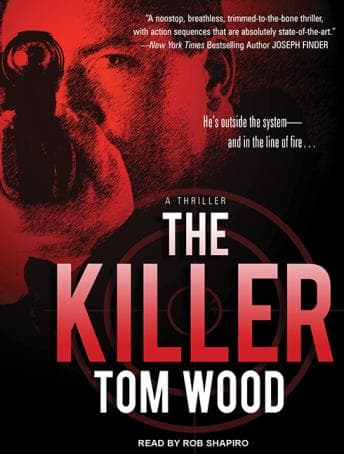

What does it actually take to be invisible? Not spy-movie invisible with a gadget watch and a tuxedo - I mean genuinely, functionally invisible. No name anyone knows. No address. No habits someone can map. Victor lives that question, and Tom Wood spends 15 hours methodically showing you the answer. I caught the first few hours during a late-night drive back from a client site outside San Antonio - empty highway, Ranger asleep in the back seat, nothing but dark road and this cold, methodical assassin working a job in Paris. The setup matched the mood perfectly.
Let me cut to the chase: this is a competent, well-researched thriller with a protagonist who actually behaves like a professional. That last part matters more than you'd think.
Victor Doesn't Make Amateur Mistakes - And That's Rare
Here's what I've seen in this genre a hundred times: the elite operative who gets sloppy the moment a woman walks in, or who somehow forgets basic tradecraft right when the plot needs him to. Wood doesn't do that. Victor checks his hotel room before entering. He sits with his back to walls. He thinks in terms of exits, sight lines, and threat assessment - not because the narrative tells us he's trained, but because that's how his internal monologue actually works. The author clearly did their homework on how a professional would actually think through a Paris kill and then manage the chaos of an ambush he didn't see coming.
The plot itself is a clean machine: job goes sideways, everyone wants Victor dead, Victor works backward through the chain to find out why. No baroque conspiracy nonsense. No world-ending MacGuffin. Just a man who's very good at one thing, applying that skill to his own survival problem. The stripped-down premise reminded me of what I appreciated about Once Solved before that series started stacking on the mythology - though Wood executes the lean thriller format with considerably more discipline. I've seen this scenario play out in real life - not the assassination part, obviously - but the moment when your intelligence picture collapses and you have to operate on incomplete information while people are actively trying to kill you. Wood captures that cognitive load honestly.
What the book doesn't do is give you much warmth. Victor is not Jack Reacher with a dry wit. He's not even particularly likable. He's functional. Effective. And occasionally, in small moments, you catch something almost human underneath the operational exterior - but Wood doesn't linger on it, which is actually the right call.
The Rob Shapiro Question
This is where it gets complicated. Shapiro has an Earphones Award and a genuinely devoted following for this series - and I understand why. His delivery is controlled, measured, and cold in exactly the way Victor needs to be. When Victor is running a threat assessment or planning a kill, Shapiro's flat affect works. It's not boredom; it's professional detachment. The character sounds like someone who has switched off the emotional circuitry most of us can't turn off.
But - and this is a real but - there were stretches around the middle of this 15-hour run where I caught myself reaching for the volume knob just to make sure something was still happening. The monotone that works for Victor's internal voice becomes a liability when the book needs to shift gears emotionally or differentiate between secondary characters in a conversation. A French intelligence officer and a CIA handler started bleeding together around hour eight. I was at 1.25x and still felt some sequences drag.
Here's my honest read: Shapiro is the right choice for this character, but he's a polarizing listen. If you need your narrator to carry you through slower passages with vocal energy, you're going to struggle. If you can settle into the cold frequency he's broadcasting on, it clicks.
Field Assessment: Who This Mission Is For
If you burned through the Mitch Rapp series and wanted someone who operates with less political baggage and more operational realism - Victor is your guy. If you like your thriller protagonists to have a moral compass, a love interest who humanizes them, and moments of levity - this isn't the assignment for you. Victor has none of those things, and the book is better for it.
Ranger slept through most of the middle section, which I'm choosing to interpret as contentment rather than editorial commentary. I'm going back for book two.
Mission accomplished - with a notation in the file about the narration.