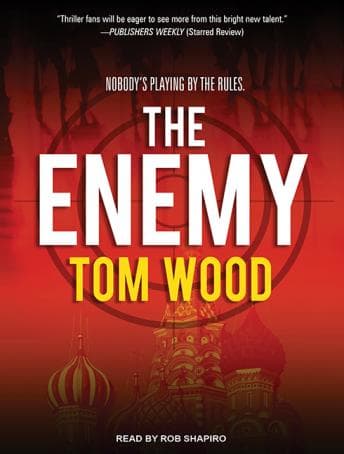

I was making dal makhani at 11 PM—the kind of elaborate cooking project my mother would approve of but question the timing—when Victor started hunting his first target. There's something about stirring butter into lentils while a professional killer methodically eliminates people that makes you think about compartmentalization. Victor has it. I apparently do not, because I burned the onions during a particularly tense surveillance sequence.
Tom Wood understands something fundamental about the psychology of violence: the people who are best at it aren't the ones consumed by rage. They're the ones who can think clearly while doing terrible things. Victor exhibits classic detachment patterns—not the Hollywood sociopath variety, but something more unsettling. He's capable of connection, of humor, of genuine human warmth. He just... turns it off when he needs to. The research actually shows that this kind of compartmentalized functioning is more common in high-stress professions than we'd like to admit. Victor is a fascinating case study in controlled dissociation, and Wood writes him with the precision of someone who's done their homework. That same precision in examining fractured psyches shows up in Brothers Karamazov, though Dostoevsky takes three times as long to get there.
When the Hunter Becomes the Hunted (And Realizes He Should Have Seen It Coming)
The conspiracy structure here is clever—three hits that seem unconnected, until they very much are. What makes Victor compelling is his dawning realization that he's been played. He's a man whose entire survival depends on reading situations correctly, and watching him process that he's missed something is genuinely uncomfortable. Not in a "this is badly written" way. In a "this is exactly how smart people feel when they've been outsmarted" way.
Psychologically, this tracks beautifully. The paranoia that develops isn't irrational—it's the appropriate response of someone who's just learned their threat assessment was fundamentally flawed. My therapist would have thoughts about Victor's trust issues, but honestly? Given his profession, they seem like reasonable adaptations.
The pacing is deliberate. Some listeners hate this. I found myself asking: why does the slow burn bother people so much? Because we're conditioned for constant action. But real intelligence work—real assassination work, I imagine—is mostly waiting. Watching. Thinking. Wood respects that. Whether you'll respect Wood for respecting that is another question entirely.
The Shapiro Divide (And Where I Fall)
Here's where things get interesting. Rob Shapiro's narration is genuinely polarizing, and I understand both sides. Some listeners call him monotone. Others praise his presentation of Victor's cerebral nature with humanity and wit. Both groups are right.
Shapiro reads Victor the way Victor would read Victor—controlled, precise, with emotion carefully contained beneath the surface. This is a performance choice, not a limitation. He keeps character accents consistent across the series, which matters for a 15-hour listen where you're tracking multiple players across multiple countries. The consistency is a feature, not a bug.
But. And this is a significant but. If you need vocal variety to stay engaged, Shapiro will lose you. I had to relisten to a few sections—not because I was confused, but because his delivery is so even that my brain occasionally treated it as background noise. Around hour 6, during a surveillance sequence, I realized I'd been thinking about a completely unrelated research paper while technically still listening. That's a problem.
The solution, for me, was dedicated listening. This isn't a "fold laundry and absorb the plot" audiobook. It's a "sit down and pay attention" audiobook. Which is fine. Not everything needs to be multitaskable.
Who This Works For (And Who Should Run)
If you want Jack Reacher's punchy efficiency, look elsewhere. If you want Jason Bourne's frenetic energy, definitely look elsewhere. Victor is a different animal—slower, more calculating, more interested in the "why" than the "how."
This is for people who like watching a character think. Who find tradecraft interesting. Who don't mind spending twenty minutes on a surveillance sequence because the psychology of waiting is part of the story. Corrections: A Novel demands the same kind of patience—different genre entirely, but the same willingness to sit with discomfort while characters process their choices. If you read spy novels for the explosions, you'll be bored. If you read them for the chess match, you'll be satisfied.
Skip this if you need action every chapter or narrators with dramatic range. It's not that kind of book, and Shapiro's not that kind of performer.
Content-wise: violence is clinical rather than gratuitous, language is present but not excessive, and there's some sexual content that feels more like character development than titillation. Nothing that would shock anyone who's read adult thrillers before.
The Case File Closes
Victor is the kind of protagonist I want to study. Not admire—he kills people for money, let's be clear about that—but understand. Wood has created a character whose psychology holds up under scrutiny, which is rarer than it should be in this genre. Shapiro's narration will work for you or it won't, and there's no way to know without trying.
I finished the dal makhani. It was excellent. Victor finished his targets. They were less excellent, being dead. Both of us completed our tasks with appropriate focus and minimal emotional investment. I'm not sure what that says about me, but my therapist probably has thoughts.