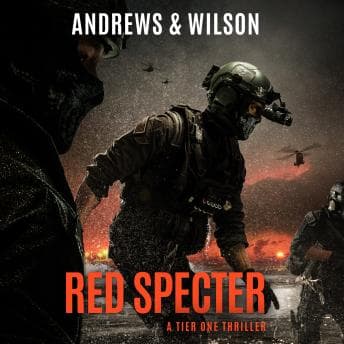

Look, I need to rant for a second. I am so tired of military thriller authors who think giving their protagonist a tragic backstory and a set of abs constitutes character development. So when I picked up Red Specter — third book in the Tier One series — while making a truly ambitious lamb biryani at 9 PM on a Tuesday (don't ask, I was avoiding my own manuscript), I had my guard up. I expected cardboard operators doing operator things while someone says "hooah" every forty pages.
I was mostly wrong. And I'm annoyed about it.
The Psychology of a Man Who Can't Stop Running Toward Gunfire
John Dempsey is a fascinating case study in identity dissolution and reconstruction. Here's a guy who was literally erased — his old life, his family, his name — and rebuilt as a weapon for a black ops task force called Ember. The protagonist exhibits classic avoidant attachment patterns, and what surprised me is that Andrews and Wilson know this about their character. They don't just make him stoic and call it a day. When he walks into that Vory arms dealer meeting early in the book and realizes he's been set up by Zeta — the Russian shadow unit — his reaction isn't just tactical. There's this moment where you feel him calculating not just survival odds but whether survival even matters to him the same way it does to his teammates. That's genuine psychological texture in a genre that usually treats interior life as an inconvenience between gunfights.
The Ember vs. Zeta dynamic works because it mirrors something the research actually shows about adversarial relationships: when two groups define themselves primarily in opposition to each other, escalation becomes identity-sustaining. Neither side can back down because backing down means losing the thing that makes them them. The strike-counterstrike structure isn't just plot mechanics — it's organizational psychology playing out with body counts.
But. And here's where I got frustrated standing over my simmering biryani. The Russian characters don't get nearly the same depth. Zeta is treated as this monolithic threat, a phoenix rising from Cold War ashes (the book's words, not mine), but I found myself asking: why does the Zeta leadership really pursue this vendetta beyond "Russia bad"? The American characters get motivations. The Russians mostly get menace. The author understands human nature — on one side of the geopolitical divide. The villain problem isn't unique to this genre — I ran into the same frustration reading Every Dead Thing, where the antagonist's menace is atmospheric but the interiority just isn't there, and it creates this same lopsided feeling where you're far more invested in the protagonist's damage than in the actual threat.
Ray Porter Does Things With His Larynx That Should Require a License
Okay, so Ray Porter. I've listened to him in other things and the man is absurdly good, but what struck me here is how he handles the ensemble. Dempsey's voice has this controlled, flat quality — the affect of someone who's trained himself not to feel things in real time — and Porter contrasts that against the warmer, more expressive voices of the supporting Ember team members. You can hear the emotional walls. That's not just good narration, that's character interpretation.
His accent work when shifting between American operators, Russian antagonists, and various international players is strong enough that I never lost track of who was speaking during the rapid-fire tactical dialogue sections. And there are a LOT of those. Thirteen hours and forty-two minutes of them. This is a commitment listen — I ended up spreading it across three days of cooking, jogging through Cambridge, and one ill-advised late night where I told myself "just one more chapter" at midnight and suddenly it was 2 AM and Dempsey was on Russian soil and I was emotionally compromised.
The moments that hit hardest are the quiet ones. Listeners apparently cried during this book and — fine, yes, there are points where the emotional stakes land hard enough that my eyes got suspiciously wet over my cutting board. Porter earns those moments with restraint. He doesn't oversell.
Who This Is Actually For (And Who Should Bail)
If you need your thriller characters to have the psychological complexity of a Dostoevsky novel, you'll be satisfied-ish but not blown away. If you want military action that actually respects your intelligence and gives its protagonist real internal conflict rather than just making him a killing machine with sad eyes? This delivers. The pacing runs hot — this is not a slow burn, this is a series of controlled detonations — and the spec ops detail has the ring of authenticity you'd expect from authors who are actual Navy veterans.
Skip it if you have zero patience for military jargon or if one-dimensional antagonists are a dealbreaker. My therapist would have thoughts about Dempsey's hero complex, and I wish the book interrogated it a little harder instead of mostly rewarding it.
My Case File Note
Psychologically, not everything tracks — the Russian characterization is thin and some of the team dynamics feel convenient rather than earned. But Dempsey himself? He's the rare action hero whose damage actually informs his decisions rather than just decorating his backstory. Andrews and Wilson built something more interesting than it had any right to be, and Porter's performance elevates it from good to genuinely immersive. I burned my biryani. Worth it.