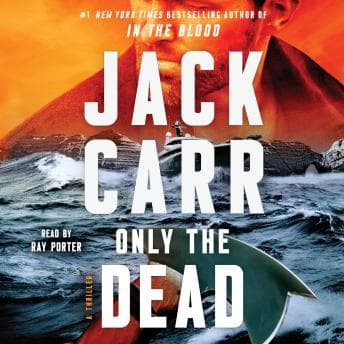

Okay, let's be real. My therapist keeps telling me I need to consume media that "soothes the nervous system." So naturally, I downloaded 15 hours of James Reece going absolute scorched earth on a global conspiracy. Sorry, Linda. (Don't tell her, actually. We're working on boundaries.)
I listened to this during my morning runs along the Charles River, and let me tell you—nothing improves your mile time quite like Ray Porter growling about tomahawks and retribution while you're trying to outrun your own tenure review anxiety.
When Trauma Becomes a Weapon
As a psychologist, James Reece is a nightmare. A fascinating, terrifying nightmare. We start with him in solitary confinement. Clinical research tells us isolation creates cognitive decline, hallucinations, and severe emotional dysregulation. For Reece? It just gives him time to organize his to-do list. And by to-do list, I mean a kill list.
Jack Carr writes this stuff with the kind of specific, technical detail that makes you wonder if he's currently on a watchlist. (He probably is, right?) The psychological profile of Reece here isn't typical "hero"—it's high-functioning trauma response weaponized into kinetic energy. It creates this weird dissonance where I'm rooting for him, but also thinking, "Please, for the love of God, process your grief." But therapy sessions don't sell thrillers. Tomahawks do.
The Voice of Controlled Chaos
Ray Porter. Look, if you know, you know. He doesn't just read the book; he embodies the tactical vest. He brought that same intensity to Terminal List: A Thriller, and honestly, I can't imagine this series without his voice now.
I read some reviews complaining that he "drones" or lacks inflection. I think that misses the point entirely. Porter's delivery is military precision. It's clipped. It's efficient. It's the voice of a man who checks his corners before entering a Starbucks. If he performed this with high theatrical drama, it wouldn't track psychologically. The detachment is the character. He sounds like he eats gravel and classified documents for breakfast.
That said—15 hours is a long time to have a gravel-voiced man whispering about global elites in your ear. There were moments during the political exposition (and there is a lot of it) where my mind wandered to my grocery list. Does that make me a bad listener? Or just human? Let's go with human.
The Conspiracy Web (Or: Why I Need a Flowchart)
Here's where the academic in me gets a little annoyed. The plot relies on a conspiracy stretching back to 1980. It's elaborate. Maybe too elaborate.
The narrative jumps from Wall Street to Moscow to DC—a lot of threads to track. At times, it felt less like a thriller and more like a lecture on geopolitical paranoia. I found myself rewinding, not because the prose was beautiful, but because I lost track of which "global elite" we were mad at. But when the action snaps back in? When Reece stops planning and starts moving? It triggers that lizard-brain fight-or-flight response that keeps me listening way past my cool-down stretch. Porter nails that same visceral intensity in Dune, though there he's channeling political intrigue on a galactic scale instead of personal vengeance.
Who's This For (And Who Should Run the Other Way)
If you want military thrillers with tactical authenticity and a protagonist whose coping mechanisms would make any clinician weep, this is your listen. Skip it if heavy political exposition makes your eyes glaze, or if you need your heroes to occasionally sit with their feelings.
Priya's Prescription
Is it perfect? No. The dialogue can be a bit heavy on the "alpha male" jargon, and the politics are... loud. But Jack Carr understands pacing, and Ray Porter understands Jack Carr. If you want a character study in vengeance that makes you run faster, this is it. Just maybe chase it with a rom-com or something. For balance.