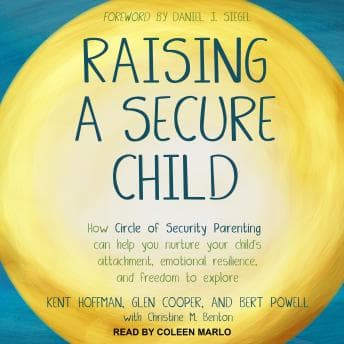

This book is doing something genuinely important, and it's also kind of a mess. Both things are true simultaneously, and I need you to sit with that tension for a minute.
I was making chana masala on a Sunday afternoon — the kind of elaborate, slow-simmering project where you're standing at the stove long enough to actually absorb nine hours of attachment theory. And honestly? The Circle of Security framework deserves that kind of attention. The core concept is elegant: children move between needing a secure base to explore from and a safe haven to return to, and the parent's job is to read which one the child needs at any given moment. Simple. Profound. The research actually shows that secure attachment isn't about being a perfect parent — it's about being a "good enough" one who can repair ruptures. As someone who studies how narratives shape identity, I found myself asking: why does this framework work so well when so many parenting models don't? Freud was asking adjacent questions about what the psyche needs versus what it receives in Dream Psychology, though his answers are considerably less useful for toddler bedtime situations. And the answer is that Hoffman, Cooper, and Powell understand something fundamental about human psychology — we don't need perfection, we need someone who sees us.
The Circle That Keeps Going Around (And Around, And Around)
Here's where I get frustrated. The Circle of Security model itself is brilliant — it emerged from decades of clinical work and attachment research, and the authors clearly know their stuff. The concept of "shark music" — that internal anxiety soundtrack that plays when your child's behavior triggers your own unresolved attachment wounds — is genuinely useful. It's the kind of metaphor that sticks in your brain and changes how you interpret your own reactions in real time.
But the book's structure? Psychologically, this doesn't track as effective pedagogy. The chapters don't build on each other in any logical progression. You'll get a concept introduced, then revisited three chapters later with slightly different language, then again two chapters after that. It's like attending a workshop where the presenter keeps circling back to the same slide but from a different angle each time. Which — okay, I see what happened here. This material was originally designed for in-person therapeutic workshops, and the translation to book form didn't fully account for the difference between guided group processing and solitary reading (or listening). In a workshop, repetition with variation is pedagogically sound because a facilitator is tracking your understanding. In an audiobook you're consuming while stirring onions? It starts to feel like you're stuck in a loop.
One listener described it as "jumping all over the show," and I wouldn't argue. By hour five, I caught myself thinking, "Didn't we cover this already?" And we had. Sort of. But with a different family example. The authors clearly wanted to approach attachment from every possible angle to make sure the concept landed, but the effect in audio form is disorienting.
What Your Parents Did To You (And What You're Doing To Your Kids)
The section I found most psychologically rich — and honestly, most personally uncomfortable — is the material on how your own attachment history shapes your parenting. This is a fascinating case study in intergenerational transmission of relational patterns. The authors aren't just saying "your childhood matters." They're walking you through the specific defensive strategies you developed as a child and showing how those same strategies now interfere with your ability to read your own kid's cues. The parent who was told to stop crying learns to minimize their child's distress. The parent who was smothered struggles to let their child explore independently.
My therapist would have thoughts about this chapter. Several thoughts. (And yes, I texted her about it. She'd already read it. Of course she had.)
Coleen Marlo narrates with a steady, warm clarity that suits the material well. She's not doing vocal fireworks here — this is a single-narrator nonfiction book, and her job is to make clinical concepts feel accessible without being condescending. She does that. The tone is compassionate without being saccharine, which is exactly what you need when someone is essentially telling you that your parenting blind spots are inherited trauma responses. I wouldn't call the performance exceptional, but it's reliably good — she disappears into the material rather than competing with it.
Who Should Listen (And Who Should Read Instead)
Honest recommendation: if you're new to attachment theory and want a practical framework for understanding your child's emotional needs, this is genuinely valuable. The Circle of Security model is one of the most research-supported parenting interventions out there, and the shark music concept alone is worth the listen. But — and this is a real caveat — you might actually be better served by the physical book. The repetitive structure that's mildly annoying in print becomes genuinely confusing in audio, because you can't flip back to check whether you've already encountered a concept or whether this is new material. If you're committed to the audiobook, listen during focused activities, not while driving. This isn't background material.
Parents who want a step-by-step behavior management system will be disappointed. This isn't about what to do when your toddler bites — it's about understanding why your reaction to the biting matters more than the biting itself.
My Clinical Notes
The protagonist here — and yes, the protagonist is you, the parent — exhibits classic patterns of defensive self-protection being mistaken for intentional parenting choices. The authors get that. They're gentle about it. Maybe too gentle sometimes, which contributes to the circular structure. But the core insight is sound: you can't give your child what you didn't receive until you understand what was missing. That's not a parenting hack. That's actual psychology. And it's worth nine hours of your life, structural frustrations and all.