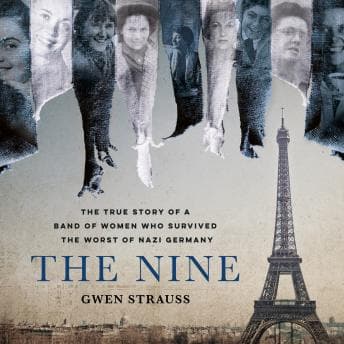

Everyone tells you to read this book because it's "inspiring" and about "the power of friendship." And yeah, it is. But that framing undersells what's actually happening here. Nine women - resistance fighters, smugglers, spies - survived Ravensbrück and a death march, then walked across war-torn Germany back to Paris. This isn't an inspirational poster. This is an operational case study in leadership under conditions that would break most Fortune 500 executives in about forty-five minutes.
I started this one on a Sunday morning while Jenny was at church. (I told her I'd catch the next one. I lied.) Thirteen and a half hours is a serious commitment - I almost didn't start it. Most WWII books I've listened to could lose four hours and be better for it. This one earns its runtime. Almost all of it. I had a similar feeling about Lincoln Highway — another long book that mostly justifies its own weight, though it's doing something quieter and less historically urgent than what Strauss is attempting here.
Nine Women, Zero Margin for Error
Gwen Strauss is the great-niece of Hélène Podliasky, who essentially served as the group's leader. And here's what got me: Hélène wasn't some mythologized hero. She was a logistics person. She organized. She made decisions about when to move, when to hide, when to split up. The escape during the death march wasn't some Hollywood sprint through the woods - it was a calculated bet, timed to a moment of chaos, executed because these women had spent months building trust and reading each other's signals.
This is what my parents did instinctively. Now it has a TED talk. Except nobody's giving TED talks about this kind of leadership because the people who lived it were too busy surviving to write LinkedIn posts about it.
What Strauss does well is differentiate the nine. These aren't interchangeable victims. Zaza, Jacky, Lon, Mena, Josée, Nicole, Guigui, Zinka, and Hélène each came to the resistance through different doors - some smuggled arms, some hid Jewish children in apartments across Paris, some coordinated communications between resistance sectors. The book tracks how the group formed across different prisons and transit points before coalescing at Ravensbrück. By the time they're enslaved at Leipzig, you understand why they function as a unit. There's a real organizational logic to their bond that goes beyond "friendship" - though it's that too.
Juliet Stevenson Didn't Have to Go That Hard
I've listened to maybe two hundred audiobooks narrated by a single voice. Most of the time, the narrator is fine. Competent. Forgettable. Stevenson is doing something different here. She shifts between French, Dutch, and German accents to mark which woman is speaking or being discussed, and it's not show-off voice acting - it's functional. You hear the class differences, the national identities, the way these women carried their backgrounds into the camps. Her French pronunciation alone tells you she did homework. Or she's just British and actually knows French. Either way, it works.
The archival recording at the end - Martine Podliasky singing "Champs de Marais" at her mother Hélène's funeral - I wasn't ready for that. I was doing dishes. Had to stop and just stand there. Jenny walked in and asked if I was okay. I said I had soap in my eye. She didn't believe me.
Where the Consultant in Me Gets Twitchy
Strauss is a poet, and sometimes the book reads like one wrote it. There are moments where the research is so dense - cross-referencing dates, locations, prisoner numbers - that the narrative rhythm stalls. Around hours six through eight, I felt the pacing soften as Strauss works to contextualize the broader war while keeping all nine stories parallel. It's ambitious structurally, and mostly it lands, but a tighter edit could've shaved ninety minutes without losing anything essential.
Also - and this is minor - the bonus author conversation at the end is interesting but feels like a DVD extra. Nice to have, not essential.
Who Gets an ROI on Thirteen Hours
If you've read Cilka's Journey or The Tattooist of Auschwitz and want something with more historical rigor and less novelistic license, this is your book. If you lead teams - seriously, any team - the way these women organized under impossible constraints is worth studying. If you're looking for light background listening while you meal prep, this is not that. You need to pay attention. The emotional weight demands it.
Skip this if you're burnt out on WWII narratives. I get it. But know that you'd be skipping something that centers women who've been largely written out of the resistance story.
The Line Item That Matters
Bottom line: I've seen consultants charge $50,000 to teach executives about "resilient leadership" and "team cohesion under pressure." This audiobook costs one credit and teaches it better. Juliet Stevenson's performance elevates already extraordinary source material. The pacing dips in the middle third, but the story never loses its grip. My parents would've understood these women immediately - the 14-hour days, the refusal to quit, the keeping-your-people-alive-through-sheer-will-and-organization. Some stories don't need a framework. They are the framework.