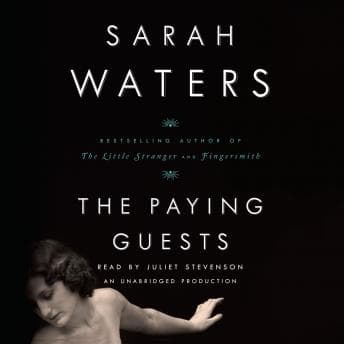

Look, I have a bone to pick with Sarah Waters. Twenty-one and a half hours. Twenty-one. And a half. Hours. I started this during faculty meetings in October and finished it somewhere around Thanksgiving, and Principal Martinez definitely noticed I wasn't paying attention to the budget projections. (I wasn't paying attention anyway, but still.)
Here's the thing though - I'm not actually complaining. This is me complaining about how I couldn't stop listening to a book that made me miss my El stop three times and nearly walk into Lake Michigan on a particularly tense Saturday morning walk with Denise.
The Slow Burn That Hemingway Would've Cut (But Waters Was Right to Keep)
Waters does something here that I try to explain to my juniors when we're slogging through The Great Gatsby and they're asking why we can't just watch the movie. She builds atmosphere like it's load-bearing architecture. 1922 London. A crumbling Camberwell villa. A widow and her spinster daughter taking in lodgers because the war took everything - brothers, husband, servants, the whole Victorian order.
Frances Wray is the kind of protagonist I wish I could assign to my AP Lit class. She's repressed in ways that feel historically accurate rather than convenient. She's doing the household labor that used to belong to servants. She's watching her mother grieve. And then the Barbers arrive - Lilian and Leonard, this "clerk class" couple who represent everything new and vulgar and alive - and the house starts to breathe differently.
The first half is domestic. Achingly, beautifully domestic. I'm talking about laundry schedules and shared bathrooms and the precise social choreography of who uses which door. My students would hate this. I loved it. Waters understands that tension doesn't require explosions. Sometimes it's just two women passing each other on the stairs.
Juliet Stevenson Made Me Miss My Stop
I need to talk about the narration because Juliet Stevenson is doing something extraordinary here. She's not just reading - she's inhabiting. Every character has a distinct voice, but it's not showy. Leonard Barber sounds like exactly the kind of ambitious, slightly oily young man who'd call himself "modern" while expecting his wife to keep house. Mrs. Wray's grief comes through in the way Stevenson slows her sentences, makes her sound tired in her bones.
But it's what she does with Frances and Lilian that got me. The way their conversations shift. The way pauses start to mean something different. Stevenson understands that in a book like this, silence is punctuation. She earns every single one of those twenty-one hours.
I listened at 1.0x because - and I know my students think I'm ancient for this - the prose deserves to be savored. Waters chose those words. Stevenson is interpreting them. Speeding it up would be like fast-forwarding through a chamber music performance.
When the Murder Arrives (And You're Already Complicit)
I'm not spoiling anything the book description doesn't already hint at - there's a crime. But Waters does something clever. By the time violence enters the story, you've spent so many hours inside Frances's head, inside the rhythms of this house, that you feel implicated. You understand how things got here. You might even have wanted them to.
The second half becomes a psychological thriller, but it never loses its literary weight. This is what I mean when I tell students that genre is a marketing category, not a quality judgment. Waters is writing crime fiction with the interiority of Henry James and the class consciousness of Woolf. That same blend of psychological depth and social commentary shows up in Strange Case of Jekyll and Hyde (Version 4 - Dramatic Reading), though Stevenson's version trades Victorian London's upper crust for its underbelly. (My podcast listeners - all 47 of them - will appreciate that comparison. Hi, Mom.)
Some listeners apparently found the pacing slow and the plot predictable. I get that. If you're coming to this wanting a thriller that moves, you might get frustrated. But I'd argue the predictability is the point. We see what's coming. We watch Frances walk toward it anyway. That's tragedy, not boredom.
Your Syllabus Check
If you loved The Remains of the Day or Atonement, this is their spiritual successor. If you want historical fiction that treats the past as a real place rather than a costume drama, Waters delivers. If you appreciate queer fiction that doesn't center trauma but doesn't shy from it either - Frances's desires are treated with the same matter-of-fact complexity as everything else.
Skip if you need your audiobooks to move faster than life. Skip if you don't have patience for domestic detail. Skip if you're looking for likeable characters - Frances makes choices you might not forgive her for, and that's kind of the point.
Class Dismissed
I finished this at 11 PM on a Tuesday, grading papers I should've been reading, and I just sat there for a while. Denise asked if I was okay. I said I was thinking about class and respectability and how people destroy themselves trying to maintain appearances. She said that sounded like a faculty meeting. She's not wrong.
Worth every one of those twenty-one hours. Worth missing my stop. Worth the suspicious looks from Martinez.