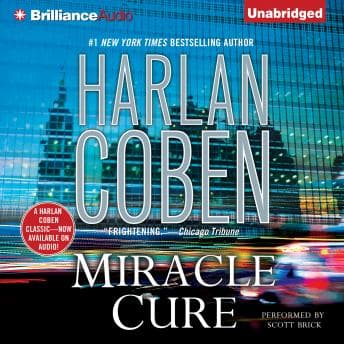

People keep telling me Harlan Coben is one of the best thriller writers working today. I've read some of his later stuff and yeah, the man knows how to build a plot. So when I saw Miracle Cure sitting there in my Audible library - his early work, pre-Myron Bolitar fame - I figured I'd get the origin story of a great thriller mind. Thirteen and a half hours later, sitting in my truck outside a client's office in Round Rock with Ranger giving me that "are we done yet" look... let me cut to the chase: this is a writer still figuring out his craft, and it shows.
Early Coben Is a Different Animal
The setup has real potential. A clinic on the Upper West Side is making breakthroughs on a devastating disease - patients are actually recovering - and then someone starts killing them off. Meanwhile, our protagonist couple is Sara Lowell, a TV journalist, and Michael Silverman, a basketball star who gets diagnosed with the same disease. It's a conspiracy thriller dressed up in medical drama, with political intrigue layered on top. Sounds like a mission briefing I'd actually want to read, right?
Here's where it lost me. Coben can't resist the sermon. The book was written in the early '90s and it feels like the early '90s - not in a charming period-piece way, but in a heavy-handed, after-school-special way. Characters don't just have opinions about the AIDS crisis (which is the disease at the center of this), they deliver speeches about it. Multiple times. To each other. While people are being murdered. I've sat through Army briefings with better dramatic pacing than some of these dialogue-heavy stretches where the plot just stops so someone can make a political point.
That said, I'll give Coben credit - the man was tackling AIDS and homophobia in mainstream thriller fiction when most genre writers wouldn't touch it. That took guts. The problem isn't the subject matter. It's the execution. When he lets the thriller mechanics run - the whodunit, the red herrings, the body count climbing - the book actually moves. But every time momentum builds, there's another three-minute detour into social commentary that could've been folded into the story naturally instead of delivered like a position paper.
Scott Brick and the Voice Problem
Scott Brick has a good voice. Period. Deep, authoritative, the kind of narrator who sounds like he should be reading you classified intelligence reports. I get why people hire him. But Miracle Cure exposes his biggest weakness: when you've got a cast this large - journalists, doctors, senators, basketball players, cops, killers - and they all start sounding like the same guy doing slightly different levels of gravitas, you're in trouble.
By hour six, I was genuinely confused about who was talking in certain scenes. Sara and her father. Michael and his doctor. Two different suspects in the same conversation. Brick defaults to this conspiratorial, melodramatic tone for tension scenes that works fine for a chapter or two but becomes exhausting over thirteen hours. It's like having a staff sergeant who only communicates in urgent whispers - after a while, nothing feels urgent.
I bumped it to 1.25x (my standard) and honestly that helped. Brick's pacing runs a touch slow for my taste anyway, and speeding it up tightened some of the narrative slack that the text itself creates.
The Mystery Underneath the Mess
Here's the thing that kept me from bailing entirely: the actual murder mystery is pretty decent. Coben throws enough suspects at you that I changed my theory at least three times. There's a genuine whodunit buried under all the preaching, and a few of the plot turns genuinely surprised me. The clinic setting works well as a pressure cooker - limited suspects, high stakes, paranoia everywhere. That's good thriller architecture, even if the furniture needs rearranging.
But I've seen this scenario play out in real life - institutions under siege, people dying, politics contaminating the investigation - and the most effective version of that story trusts the reader to understand the stakes without being lectured. Coben's later books do this. Miracle Cure doesn't. It's like watching a lieutenant's first operational plan: all the right pieces are there, the instincts are solid, but the execution needs a few more deployments to sharpen up.
Who Should Saddle Up (And Who Should Stand Down)
If you're a Coben completist who wants to trace his evolution from raw talent to polished pro, this is worth streaming through your library app. You can actually see the DNA of his later, tighter books forming here. If you're new to Coben? Start literally anywhere else. Tell No One, the Bolitar series, pick one. Coming in cold to Miracle Cure would be like judging a soldier's career by their first day at boot camp. I had a much better entry-point experience with Close to Home — that one hits the ground running and never stops to lecture you.
Mission Debrief: Incomplete
Worth your time? Only if you're already invested in the Coben catalog and want the archaeology. The story has bones but needs surgery. The narration gets the job done but won't win any commendations. Ranger fell asleep during this one, and for once, I don't blame him.