
"Ninety-five miles an hour. That's what Danny can throw. And he still can't get the ball anywhere near the strike zone."
I was sitting in my car — yes, THE car, the one parked in the garage where I hide for 45 minutes before going inside — when that detail landed. Not because I know anything about baseball pitching mechanics (Lucas is in T-ball and mostly just eats dirt), but because I know what it looks like when a kid has everything he needs to succeed and still crumbles. As a mom, that image broke something open in me.
A Kid Who Can't Fit Inside His Own Skin
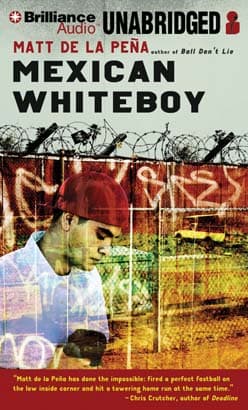
Mexican WhiteBoy is technically a YA novel. I picked it up because my friend Jen keeps telling me to "read outside my comfort zone" and honestly because at 7 hours it fit perfectly into my week. But here's the thing — this isn't really a baseball book. It's about Danny Lopez, a half-Mexican, half-white kid spending the summer in his dad's old neighborhood in San Diego, trying to figure out which half of himself is the real one. His dad went back to Mexico. His mom is blonde and blue-eyed. Danny can't speak Spanish. And he's convinced his whiteness is the reason his family fell apart.
That last part? I had to pause the audiobook and just sit with it. A teenager who believes he is fundamentally wrong. Who thinks the problem is literally coded into his DNA. I've got three little ones still in the phase where they think they're invincible and perfect, and the idea that the world will eventually try to convince them otherwise made me want to march inside and squeeze all three of them. (I didn't. Sophie had just fallen asleep and I value my sanity.)
Matt de la Peña writes kids the way kids actually are — messy, contradictory, trying on different versions of themselves like outfits they'll grow out of. Danny barely talks for entire chapters of this book. He just... absorbs. And the friendship between Danny and Uno, this loud, brash kid from the neighborhood who's dealing with his own secret struggles, feels real rather than forced. They need each other for completely different reasons, and neither one fully admits it until way past the point where it's obvious to everyone else. The hustle they run together — Uno betting locals that Danny can hit targets with his fastball — is such a specific, lived-in detail. It's not just a plot device; it's how two kids who don't know how to talk about feelings find a language that works.
I need to flag something: there's self-harm in this book. It's not gratuitous, but it's there, and it's treated seriously. If you're thinking about handing this to your middle schooler — and you should think about it — read or listen to it first. Know what conversations it might open.
Henry Leyva's Voice Does the Quiet Work
The narration is the kind of understated-good that sneaks up on you. Henry Leyva doesn't go for big dramatic swings between characters. It's more like he adjusts the temperature. Danny's sections are almost hushed, a little guarded, like a kid who's trained himself to take up less space in any room. Then Uno shows up and Leyva opens up — bigger, brassier, with this loose confidence that instantly tells you everything about the gap between these two boys before a single word of backstory drops.
The Spanish woven through the dialogue lands naturally. No "performing an accent for the audience" energy, just the way bilingual families actually sound when they're code-switching at the dinner table. My one small gripe echoes what other listeners have said: I wanted more Spanish. The book is set deep in a Mexican-American neighborhood in San Diego, and while the Spanish that IS there feels authentic, I kept wanting more of the grandmother's voice, more neighborhood texture in that language.
But — and this is my real litmus test — Leyva survives the pause. Survived 47 pauses and still made sense. I came back after a Sophie meltdown involving an entire cup of goldfish crackers pulverized into the living room rug, hit play, and immediately knew who was speaking and where we were in the story. That's not nothing. That's craft. Henry Leyva's work on Identical gave me that same steady, who's-who clarity—it's a totally different kind of story, but his ability to shift voices without showboating is just as locked-in.
The One I'm Keeping for When My Kids Are Ready
Honest assessment: this is not my usual lane. I live in contemporary romance and light fiction because my actual life provides more than enough emotional complexity. Mexican WhiteBoy made me cry at school pickup. Worth it though. Not because of one devastating scene, but because of this slow, steady accumulation — a kid trying so hard to earn belonging in a place that should just be his by right.
If you're a parent of little kids, this will gut you in a very specific way. Not because your children are Danny's age yet, but because it forces you to think about every box the world is already preparing to shove them into. If you've got kids around 12 to 14, this might be one of the most useful books you could hand them. Or better yet — listen first, hand it over, then actually talk about it. (Aspirational parenting advice from a woman who can't get through a shower without someone pounding on the door.)
I finished this in five days across school drop-offs and car-in-garage sessions. Not groundbreaking, but sometimes you don't need groundbreaking. Sometimes you need a book that's honest and specific and makes you a slightly more thoughtful parent by the end. My book club will love this — if I ever have time for book club again.