
I was making dal makhani at 10 PM on a Tuesday — the kind of absurdly involved recipe that requires you to soak black lentils overnight and then babysit them for hours — when Henry Leyva started describing thirty-three men rationing two spoonfuls of tuna fish every forty-eight hours, 2,300 feet underground in a Chilean copper mine. I turned off the stove. The dal could wait.
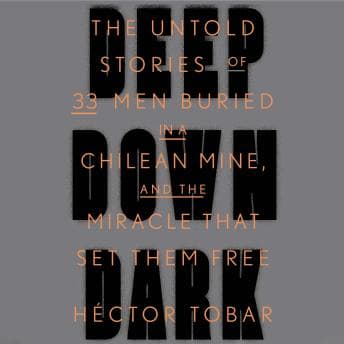
Héctor Tobar's Deep Down Dark is, on its surface, about the 2010 San José mine collapse. You probably remember the news footage — the capsule emerging from the earth, men in sunglasses blinking at cameras, the world cheering. But Tobar, who got exclusive access to the miners' stories, does something far more interesting than replay the rescue. He builds a psychological portrait of what happens to human identity when every external reference point — sunlight, time, social role, family — is stripped away.
I found myself asking: why does this book work so much better than it should? We know they survive. There's no mystery. And yet.
Thirty-Three Men, Thirty-Three Ways to Fall Apart
What makes this book psychologically fascinating is how Tobar tracks the group dynamics of slow-motion crisis. The protagonist here isn't one person — it's a collective, and the collective exhibits classic stages of group behavior under existential threat. You get the emergence of informal leadership (shift foreman Luis Urzúa trying to maintain structure), the fracturing along religious lines (José Henríquez organizing evangelical worship services deep in the tunnels, which not everyone appreciated), and the quiet rivalries over who controls the dwindling food supply.
The research actually shows that small groups under extreme stress tend to either consolidate around shared ritual or splinter into factions. Tobar captures both happening simultaneously, sometimes within the same scene. One moment the men are praying together; the next, someone is secretly hoarding crackers. It's not contradictory. It's human.
And then there's the stuff happening above ground — the wives, mothers, girlfriends (and in some cases, the wife AND the girlfriend showing up at the same vigil site, which... my therapist would have thoughts about that particular dynamic). Tobar doesn't shy away from the messiness. The fame. The jealousy. The way survival itself becomes a commodity that people start fighting over before the men are even out of the ground.
Leyva's Quiet Discipline
Henry Leyva narrates this with a restraint that I initially mistook for emotional distance. His voice is clear, measured, almost journalistic — which tracks, given the source material. But here's where it gets interesting: his bilingual fluency does real work. When he shifts into Spanish for names, places, prayers, there's no awkward pause or overcorrection. It's the kind of code-switching that sounds like someone who actually lives between two languages, not someone performing bilingualism for an audience.
The sections where Henríquez leads worship underground — Leyva handles these with a kind of careful gravity that lets you feel the tension between the believers and the skeptics without editorializing. He's not telling you how to feel about faith in a collapsing mine. He's just... presenting it. And that restraint is actually more unsettling than dramatic narration would be.
Is it unemotional? Maybe. But I'd argue that's the right call for material this intense. If Leyva had gone full dramatic performance during the hunger sequences or the moments when the men hear the drill bit break through rock for the first time, it would've tipped into melodrama. Instead, the horror builds through specificity — the smell of the rock dust, the way darkness becomes a physical weight, the moment someone realizes their headlamp batteries are dying and what that means.
At thirteen and a half hours, this is not a quick listen. And the middle section — the waiting, the monotony, the slow psychological erosion — mirrors what the miners experienced. That's either brilliant structural storytelling or a pacing problem, depending on your tolerance. I lean toward the former, but I'll admit there were moments around hour eight where I had to resist the urge to skip ahead to the rescue.
Who This Is Really For
If you watched The 33 (the Antonio Banderas film) and thought "that was fine but kind of shallow" — this is your corrective. The movie couldn't do what Tobar does, which is sit inside the psychological texture of prolonged crisis. Films need action. Books can afford to be still.
This is for people who want to understand group psychology under pressure, who are interested in how identity reconstructs itself after trauma, and who can handle a slow burn that earns its emotional payoff. If you need constant plot momentum, this will frustrate you. If you're okay marinating in the claustrophobia for a while — and I mean really sitting with it — this is a remarkable piece of narrative journalism.
Skip it if you're looking for bedtime listening. I made that mistake once during this book and had extremely vivid dreams about being trapped in my building's elevator. Not recommended. The only other audiobook that's done something similar to my sleep schedule is Twas The Nightshift Before Christmas — different stakes entirely, but that same quality of someone narrating real human suffering with a precision that gets under your skin at inconvenient hours.
The Case File Stays Open
What stayed with me isn't the rescue. It's the aftermath — how the miners struggled with fame, with each other, with the expectation that they should feel grateful every single day for the rest of their lives. Tobar understands that survival isn't the end of a story. It's the beginning of a much harder one. Psychologically, that's exactly right. And it's what elevates this from journalism into something closer to a study of what humans become when the mountain swallows them whole and then — improbably, impossibly — spits them back out.