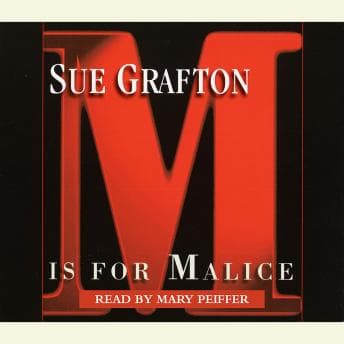

Sue Grafton understood something fundamental about human behavior: money doesn't create dysfunction in families — it reveals it. And M Is For Malice is basically a 9-hour case study in what happens when a $40 million inheritance forces four brothers to confront 18 years of resentment they've been marinating in.
I was elbow-deep in a lamb rogan josh when the Malek family dynamics really started clicking into place for me. Onions caramelizing, spices blooming, and Kinsey Millhone methodically peeling back layers of a family that would rather lose a brother forever than split their fortune another way. There's something fitting about cooking a dish that requires patience while listening to a detective who operates the same way.
The Psychology of the Prodigal Son (Minus the Forgiveness)
The premise here is deceptively simple: find the missing brother. But what Grafton does — and what makes this book a fascinating case study in family systems theory — is show how each Malek brother has constructed an entire identity around the absence of the fourth. Guy Malek isn't just missing. He's the family scapegoat, the one whose disappearance let everyone else solidify their roles. The black sheep who conveniently isn't around to defend himself.
The protagonist exhibits classic Kinsey patterns: she's methodical, she's wry, she keeps emotional distance until she can't. But I found myself asking: why does Kinsey really care about Guy beyond the paycheck? Grafton plants something interesting there — Kinsey's own fractured family history makes her a sucker for lost-and-found stories, even when every instinct should tell her to walk away. The parallel isn't heavy-handed, which I appreciated. It's just... there, humming underneath.
Where the book loses me slightly is in the murder setup. When it comes — and you know it's coming because Grafton practically waves a flag — the "who" is less surprising than I wanted. The research actually shows that in family annihilation cases, the motive is almost always about perceived loss of status or resources. Grafton follows this pattern faithfully, maybe too faithfully. I wanted her to subvert my expectations. She didn't.
Mary Peiffer and the Problem of Too Many Brothers
Here's where I have to be honest. Mary Peiffer's narration is... fine? She captures Kinsey's sardonic internal monologue reasonably well — that conversational, slightly detached tone during interviews and interrogations works. But the Malek brothers? I genuinely could not tell Donovan from Bennet from Jack at points. Four male characters who are already described as variations on the same genetic theme, and Peiffer gives them essentially the same vocal register with minimal differentiation.
There were stretches of dialogue — particularly in the family confrontation scenes — where I had to rewind and figure out who was actually speaking. Not because Grafton's writing was unclear, but because the vocal delivery flattened the distinctions. One listener nailed it: "Many times it was confusing which character was speaking." Yeah. That.
Peiffer also clips her delivery in spots, rushing through connective scenes like she's trying to get to the good parts. But with Grafton, the connective scenes ARE the good parts. Kinsey's observations about furniture placement in someone's office, the way she notices what someone's wearing — those details are doing psychological work. They shouldn't be speed-read.
I've heard some listeners swear by Judy Kaye's versions of the alphabet series, and I get it. Peiffer isn't bad. She just doesn't give you enough to hold onto when the cast gets crowded.
Who Gets the Inheritance (Of This Audiobook, I Mean)
If you're already deep in the Kinsey Millhone alphabet and you've been listening in order, you'll push through and probably enjoy it. The mystery itself is solid mid-series Grafton — not her sharpest puzzle, but the character work carries it. If you're new to the series, do NOT start here. You'll miss the accumulated weight of Kinsey's emotional history, and frankly, the narration won't help you figure out who matters.
Psychologically, this doesn't track as Grafton's best work — the killer's motivation feels a bit undercooked compared to, say, the antagonist in H Is For Homicide. But the family dynamics? The way resentment calcifies over decades until someone becomes unrecognizable? That tracks perfectly.
My therapist would have thoughts about every single Malek brother. And also about me, for spending a Saturday night alone with lamb curry and a fictional murder. But we've discussed this.
My Clinical Notes
M Is For Malice is a competent entry in a beloved series, slightly hampered by narration that can't quite handle its ensemble cast. Grafton's understanding of how families weaponize memory and money remains sharp. The audiobook experience, though, requires more active attention than it should — not because of complexity, but because you're doing the narrator's differentiation work for her. Worth your time if you're a completist. Worth a sale price if you're browsing. On the subject of mysteries that coast on genre comfort rather than genuine craft, I had a similar experience with Gingerbread Cookie Murder — competent, familiar, and about as surprising as finding butter in a cookie recipe.