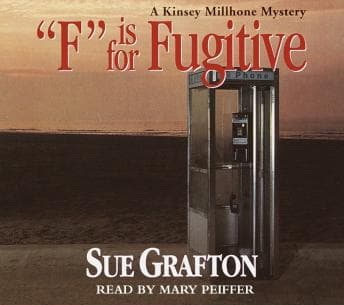

Look, I need to lodge a complaint with Sue Grafton's ghost. I was making chicken tikka masala from scratch — the kind that takes three hours because you toast your own spices and make the marinade properly — and I'd planned to listen to something light while I cooked. F Is for Fugitive is not that. By the time Kinsey Millhone starts pulling at the threads of a seventeen-year-old murder in a sleepy coastal California town, I'd forgotten about the cumin seeds on the stove. Burnt cumin smells like regret, for the record.
But here's the thing that actually annoyed me: I saw the ending coming. Not all of it, but enough. And that bugs me, because Grafton is usually better at misdirection than this.
The Psychology of a Town That Won't Let Go
What Grafton does well — and this is consistent across the Kinsey Millhone books — is create a closed social ecosystem where everyone's pathology feeds everyone else's. The Fowler family is a fascinating case study in codependency and unresolved grief. You've got Royce, the dying father who'd rather spend his last dollars proving his son's innocence than accept the possibility that Bailey actually killed Jean Timberlake. There's Ann, the daughter who's basically sacrificed her entire adult life to caretaking, radiating resentment she won't name. And Bailey himself, who confessed to murder and then escaped prison, which — psychologically, this doesn't track as a simple guilty plea. Grafton understands that. The whole book is really asking: why does someone confess to something and then run?
I found myself asking: why does this small town resist Kinsey so hard? It's not just that they're protecting secrets (though they are). It's that Kinsey's investigation threatens the narrative everyone's constructed to survive. The research actually shows that communities process collective trauma by creating shared stories, and when an outsider challenges those stories, the response looks a lot like what happens to Kinsey in Floral Beach — hostility, obstruction, even violence. The town isn't hiding a murderer. It's protecting its own psychological architecture.
The victim, Jean Timberlake, is drawn with more dimension than you'd expect for a dead girl in a mystery novel. She's not just a body or a symbol. Grafton gives her a complicated interior life — promiscuous, troubled, from a family with its own dysfunction — and refuses to make her either a saint or someone who "deserved it." That matters. A lot of crime fiction treats victims like plot devices. Grafton treats Jean like a person whose choices made terrible sense given her circumstances. I noticed something similar in Dead Men's Money — the victim's backstory is treated with the same kind of unglamourized humanity, though the mystery mechanics are considerably rougher around the edges.
Mary Peiffer IS Kinsey Millhone (And I Mean That)
So here's the narrator situation. Mary Peiffer voices the early Kinsey books, and listeners who started with her tend to be fiercely loyal — "Mary Peiffer will always be Kinsey to me" is basically the rallying cry. I get it. There's a dry, no-nonsense quality to her delivery that matches Kinsey's first-person narration perfectly. Kinsey is sardonic without being performative, tough without posturing, and Peiffer captures that register consistently across nearly seven hours.
Where it gets tricky: I don't have strong evidence of distinct vocal characterization between the supporting cast. This is a book with a LOT of characters — the Fowlers, various townspeople, a church pastor with secrets, Kinsey's temporary landlord. In a single-narrator production with no sound effects or music, differentiation matters, and I honestly couldn't tell you that each character sounds markedly different. Peiffer's strength is Kinsey's internal voice — the running commentary, the observations, the moments where Kinsey's professional detachment cracks. That she does well. The emotional delivery lands, especially in the later chapters when things get genuinely dangerous.
At seven hours, this is a tight listen. No bloat. The pacing matches the investigation — methodical in the first half, accelerating as Kinsey gets closer to the truth and closer to real physical danger.
Who Should Investigate and Who Should Stay Home
If you're already invested in the Kinsey Millhone series, this is a solid entry. Not the strongest — I'd put it middle of the pack — but the family dynamics carry it even when the mystery mechanics feel slightly predictable. If you're coming to Grafton for the first time, honestly, start with A Is for Alibi. The alphabetical thing isn't just a gimmick; Kinsey develops across books, and meeting her at Book 6 robs you of context.
If you need every character to sound like a different person, single-narrator productions with large casts might frustrate you here. But if you're the kind of listener who's really there for the detective's perspective — her psychology, her process — Peiffer delivers that.
My therapist would have thoughts about Ann Fowler. Several sessions' worth, probably. The way she channels all her anger into competence and caretaking while her family implodes around her? I've read about this in textbooks. Grafton just made me feel it over burnt cumin.
The Case File, Closed
F Is for Fugitive is a good mystery wrapped in excellent family psychology. The whodunit isn't Grafton's most surprising, but the why-they-did-it is sharp and human and sad in a way that sticks. Worth your time if you're working through the series. Worth a credit if Kinsey's voice — Peiffer's version of it — is the one you hear when you think of these books.