What happens to a mystery when the victim's life was darker than the crime itself?
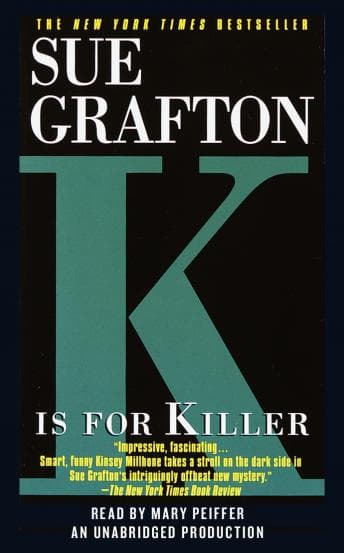
I was shelving returns at the library after hours—just me and the fluorescent hum—when I hit play on this one. Seemed appropriate. Kinsey Millhone spends most of K Is for Killer working the graveyard shift, literally restructuring her sleep schedule to inhabit the nocturnal world where Lorna Kepler lived and died. And honestly? That commitment from Grafton is what separates this from your average PI procedural.
The Night Shift Detective
Grafton does something clever here that I don't see enough in the genre: she makes the investigation methodology part of the story's texture. Kinsey can't just interview people during business hours because Lorna's world—the late-night DJ, the teenage sex worker, the shady landlord—doesn't operate on a 9-to-5 schedule. So Kinsey adapts. She becomes nocturnal. By the midpoint, you're right there with her, caffeinated and disoriented, meeting sources at 2 AM in diners that smell like burnt coffee and desperation.
The victim herself is fascinating. Lorna worked at a water treatment plant by day—could there be a more deliberately mundane job?—while moonlighting in prostitution and pornography. Grafton refuses to make this salacious or tragic in the expected ways. Lorna was apparently good at compartmentalizing, and the book lets that complexity breathe without judgment. My podcast listeners would appreciate this. Horror and mystery both suffer when creators moralize instead of observe. Odd Hours walks that same tightrope—observing its protagonist's strange world without judgment.
Mary Peiffer Knows This Woman
Here's the thing about long-running audiobook series: the narrator becomes inseparable from the character. Mary Peiffer has been voicing Kinsey across this alphabet mystery series, and by K, she's not performing anymore. She's inhabiting. There's a lived-in quality to her delivery—the dry observations, the self-deprecating humor, the moments where Kinsey's professional detachment cracks just slightly.
Peiffer doesn't do flashy character voices. She doesn't need to. What she does instead is modulate Kinsey's internal monologue with such precision that you forget you're listening to narration at all. It's closer to eavesdropping on someone's thoughts. The secondary characters come through clearly enough, but this is Kinsey's show, and Peiffer understands that.
I've been listening to audiobooks in the dark for years now (yes, I've scared myself, yes, I'm a coward, no regrets), and the narrators who work best in that context are the ones who trust the material. Peiffer trusts Grafton. She doesn't oversell the tension or melodramatize the reveals. When Kinsey realizes something disturbing, Peiffer lets the words do the work.
The Slow Burn of a Cold Case
Ten months cold, the case. That's a lot of dead ends and faded memories. Grafton leans into this—the investigation feels appropriately frustrating at times. You're not getting neat clues that click into place. You're getting contradictions, half-truths, people who remember Lorna differently depending on which version of her they knew.
At 9 and a half hours, the pacing is deliberate. Not slow, exactly, but methodical. Kinsey interviews, re-interviews, circles back. If you need constant action, this will test your patience. But if you appreciate the craft of investigation—the way a good detective builds a picture from fragments—this gets it. Mystery isn't about gore. It's about dread. The creeping realization of what happened and why.
The netherworld Grafton references in the description isn't supernatural. It's social. Echo Burning explores a different kind of hidden world—one where violence simmers just beneath small-town Texas normalcy. The late-night ecosystem of sex workers, insomniacs, and people who've opted out of daylight society. Kinsey has to earn her place there, and watching her navigate it is genuinely compelling.
Who Gets the Library Card (And Who Doesn't)
If you're already invested in Kinsey Millhone, this is essential. If you're new to Grafton, you could start here—K works as a standalone—but you'd miss the accumulated weight of knowing Kinsey. Series readers will recognize her apartment, her habits, her particular brand of stubborn integrity.
Skip if you need fast-paced thriller energy. This is a character study wrapped in a murder investigation, and it moves at its own pace. Also, content warnings for violence, language, and sexual content—Lorna's world isn't sanitized.
Perfect for late-night listening. Obviously. Shirley (my cat) was unimpressed by the lack of actual killers appearing on screen, but I was thoroughly absorbed.
Shelved Under: Worth Your Time
Grafton earned her Grand Master status, and K Is for Killer shows why. This isn't horror, but it understands something horror knows well: the scariest thing isn't the monster. It's the ordinary life that concealed one. Peiffer delivers it with the confidence of someone who's been living with this character for years. Mystery that respects the genre—finally.