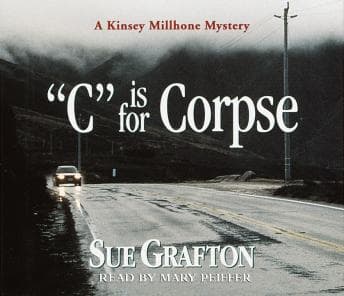

I was halfway through making my mother's rajma recipe — the one that requires you to stand at the stove stirring for an unreasonable amount of time — when Bobby Callahan died. Three days after hiring Kinsey Millhone. I put the spoon down. Just stood there in my kitchen like an idiot, staring at the pot, because Sue Grafton had somehow made me care deeply about a twenty-year-old kid with a shattered face and Swiss cheese memory in under two hours of audio.
That's the thing about C Is For Corpse. It shouldn't work this well. The premise is almost tropey — amnesiac client, suspicious accident, PI hired to uncover the truth. But Grafton understands something that a lot of mystery writers don't: the most interesting puzzle isn't whodunit. It's why someone becomes worth killing.
Bobby Callahan Is the Best Kind of Psychological Portrait
The protagonist exhibits classic traumatic brain injury presentation — memory gaps, personality shifts, frustration that borders on rage — and Grafton wrote this in 1986, before half the neuropsych research we have now. Bobby's not just a plot device. He's a young man trying to reconstruct an identity from fragments, and the specific way he clings to Kinsey as his last rational lifeline? That's textbook attachment behavior under threat. He knows something got him nearly killed but he can't access it, and the terror of that — knowing your own mind holds evidence you can't reach — is genuinely well-rendered.
I found myself asking: why does Bobby really hire Kinsey? On the surface, protection. But psychologically, this is a person who's lost agency over his own narrative. He's hiring someone to reconstruct his story for him. That's not just detective work. That's existential.
That same existential pull is what kept me turning pages in U Is For Undertow: A Kinsey Millhone Novel, where Grafton pushes the recovered-memory angle even further into genuinely unsettling territory.Grafton also does something clever with the Callahan family dynamics. The money, the stepfather, the mother's anxiety that reads as performance — she layers in enough family pathology that you're suspicious of everyone at the dinner table, which is exactly how it should feel. The research actually shows that in cases of domestic-adjacent violence, the perpetrator is statistically someone the victim trusts. Grafton knew this instinctively.
Peiffer's Kinsey: Dry Enough, Deep Enough
Mary Peiffer gives Kinsey this slightly deep, no-nonsense voice that I initially wasn't sure about — it felt almost too flat in the first chapter, like she was reading a deposition rather than narrating a life. But by the time Kinsey's breaking into someone's office (as one does), the voice clicked. Kinsey Millhone is not a warm person. She's sharp, self-contained, a little prickly. Peiffer's delivery captures that dryness in a way that a more theatrical narrator would've ruined.
That said — and this is where it gets uneven — Peiffer's character differentiation is pretty thin. Bobby, his stepfather, the various suspects: they blur vocally. During interview scenes, I occasionally lost track of who was speaking, especially when the dialogue moved fast. There are also these odd little pauses mid-sentence that don't correspond to any grammatical or dramatic logic. Not dealbreakers, but noticeable. Like someone hitting the wrong beat in a jazz song — you feel the stumble even if the melody recovers.
Her best work is in Kinsey's internal monologue. The wry asides, the self-deprecating observations about her terrible eating habits and her cheap apartment. Peiffer reads those moments with just enough smirk that you can hear Kinsey's personality without it becoming a caricature. My therapist would have thoughts about Kinsey's attachment avoidance, by the way. The woman literally lives in a converted garage and considers that aspirational.
What Makes This Mystery Work (and What Doesn't Quite)
The plotting is tight — Grafton doesn't waste scenes, and at just under eight hours, the pacing earns its runtime. The clue structure is fair-play enough that you can piece things together if you're paying attention, though the final reveal leans on a connection that felt slightly under-seeded. I wanted one more scene establishing that link earlier. Just one.
But the character work carries everything. This is a fascinating case study in how grief fuels investigation. Kinsey takes Bobby's case out of professional duty, but after his death, the motivation shifts to something rawer. She never welshed on a deal — that's the surface justification. The real psychology is guilt, anger, and the particular stubbornness of someone who refuses to let a dead client down because she couldn't protect a living one.
Grafton gets people. She just does. The way she writes Kinsey navigating the Callahan family's wealth and dysfunction — always an outsider, always cataloging tells and micro-expressions — reads like someone who studied behavioral observation without ever calling it that.
Who Gets the Most Out of This
If you want a mystery where the detective is psychologically coherent and the victim is treated as a person rather than a plot starter, this is your book. Fans of Sara Paretsky or Tana French's character work will feel at home here. If you need high-drama voice acting or strong character differentiation in your narration, Peiffer might frustrate you — consider this a "story first, performance solid" kind of listen.
And if you're working through the Alphabet series: C is where Grafton really finds the emotional register that makes Kinsey more than just a competent PI.
Case File: Closed, With Annotations in the Margins
I finished the rajma. It was good. Bobby Callahan was still dead. And I sat at my kitchen table thinking about how memory loss is the cruelest plot device in mysteries because it mirrors what trauma actually does to people — it steals the narrative, forces you to rely on others to tell you who you are. Grafton understood that thirty-nine years ago. The research is just now catching up.