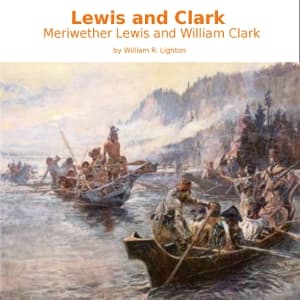

Let me cut to the chase. I picked this one up because I had a three-hour drive out to a client's ranch in Hill Country and didn't have the mental bandwidth for a thirty-hour deep dive into geopolitical theory. I wanted a classic recon mission. And honestly? You don't get much more classic than the Corps of Discovery.
Lewis and Clark. Two captains, a bunch of rugged volunteers, and a map that was mostly blank. That's the kind of logistics nightmare that keeps me up at night—but in a good way. So I loaded up Lewis and Clark by William R. Lighton, cranked the speed to 1.25x, and let the miles roll.
The Briefing (Narrator Performance)
Roger Melin handles the comms on this one. I hadn't heard him before, but the man is solid. Clear, direct, no unnecessary theatrics. In the military, we call this "command voice"—he's not trying to act out every single rapid or grizzly bear attack with silly voices. He's just delivering the intel.
(Ranger was asleep in the back seat, but even he didn't whine, which is high praise considering he usually hates high-pitched narrators.)
Melin's pacing is steady. He doesn't rush the heavy parts, and he keeps the travelogue sections moving. Since this is a shorter book—just over three hours—he doesn't have time to drag his feet. He treats the text with respect, even when the text itself gets a little... problematic. Which brings me to my next point.
The Intel is Dated (Fair Warning)
Here's the thing. You need to know going in that Lighton wrote this in the early 1900s. And man, does it show.
I've spent enough time in the sandbox to know that if you underestimate the locals, you fail the mission. Simple as that. But this book? It's got that old-school, turn-of-the-century attitude where the Native Americans are treated as scenery or obstacles rather than complex nations. There's a lot of talk about "civilization" vs. "savagery" that made me wince. It misses the tactical reality that the Corps of Discovery would've been dead in a week without Indigenous intel and support.
So, if you're looking for a modern, nuanced take on the cultural exchange? This isn't it. This is a product of its time. You have to listen with a filter.
Mission Assessment
If you can look past the dated worldview, the core of the story still hits. The logistics of moving that many men up the Missouri River, the discipline required, the sheer guts of crossing the Rockies before winter... that stuff never gets old. Lighton captures the "boys' own adventure" vibe pretty well.
It's not a comprehensive after-action report. It skips over details that modern historians would obsess over. For a different kind of historical account—one that's told through first-person voices—My Confession does something similar with the Mexican-American War. But as a high-level overview? A quick refresher on one of the greatest troop movements in American history? It does the job.
Who Should Listen (And Who Should Skip)
If you want a quick, digestible intro to the expedition—something for a road trip or fence-checking duty—this works. Skip it if you need modern historical analysis or can't stomach early 1900s attitudes toward Indigenous peoples. For the definitive account, go find Undaunted Courage instead.
The Debrief
Is it the best book on Lewis and Clark? No. But is it a solid way to kill three hours while checking perimeter fences or driving down a Texas highway? Absolutely.
Roger Melin elevates the material. He takes a dusty text and makes it listenable. Just keep your head on a swivel regarding the historical bias.
Mission accomplished. Now, time to get Ranger some water.






![Steve Jobs [unabridged audiobook] audiobook cover](/_next/image?url=https%3A%2F%2Fcovers.audiobooks.com%2Fimages%2Fcovers%2Ffull%2F9788499923406.jpg&w=1920&q=75)