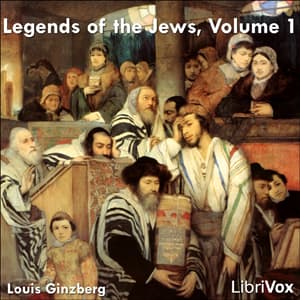

Denise and I had a disagreement last Saturday. She wanted to walk the lakefront in companionable silence. I wanted to listen to a 13-hour LibriVox recording of Talmudic midrash compiled by a Lithuanian rabbi who died in 1953. We compromised. She walked. I wore one earbud and nodded periodically at the lake.
That's how I started Legends of the Jews, Volume 1. And I want to be honest with you about what this is before you go in expecting something it isn't.
What Ginzberg Actually Built Here
Louis Ginzberg spent decades collecting the midrashim — the rabbinic expansions, elaborations, and interpretive stories that grew up around the Torah over centuries. You know how the Bible mentions Abraham but doesn't explain what he was doing before God called him? The midrash explains. In detail. With angels. And arguments. And a young Abraham smashing his father's idols with a hammer and then blaming the largest idol for the damage when his father comes home, just to prove a point about the absurdity of idol worship.
That story stopped me cold on the lakefront. I actually paused, rewound, and listened again. Because that's not in Genesis. That's a story about Genesis, and it's been passed down through Jewish tradition for so long that it feels like it should be canonical. Ginzberg's genius was synthesizing thousands of these stories — from the Talmud, from the Midrash Rabbah, from medieval texts — into one continuous narrative voice. The result reads less like scholarship and more like someone's very learned grandfather telling you everything the Bible left out.
The prose deserves to be savored. Ginzberg writes with the quiet authority of someone who has read everything and is now patiently explaining it to you. This is why we still read the classics — and this book sits in that tradition of essential texts that serious readers of scripture, in any tradition, should encounter. I'll admit the bar for "essential" gets thrown around loosely — I gave Grace, Not Perfection a fair shake last year and walked away thinking that one probably doesn't clear it — which makes it all the more meaningful when something actually does.
The Narration Situation (Let's Be Honest)
This is a LibriVox production. Multiple volunteer readers. And that means the listening experience is — how do I put this charitably — uneven in ways that will either charm you or exhaust you depending on your temperament.
Some readers are genuinely good. Clear, measured, respectful of the text's weight. Others read like they're filing a tax return aloud. The narrator who handled the Creation sections had a pace so deliberate it felt like they were leaving space for God to respond. That worked, actually — there's something appropriate about treating the creation of the universe like it deserves a pause between sentences. But then another narrator would come in for a different section and the tonal whiplash was real.
Here's what I keep coming back to: the narrator understands that pause is punctuation — or at least, the better narrators here do. When the text describes Adam naming the animals, a competent reader lets that land. When it doesn't land, you feel the loss acutely because the material deserved better. My students would call this a problem. I call it the cost of accessing a free recording of a genuinely important text.
If you've listened to any LibriVox production before, you know exactly what you're getting. If you haven't, I'd suggest starting with their better-produced titles before committing to nearly 14 hours of this one.
Who This Is Actually For
If you loved the Hebrew Bible as literature — not just as scripture but as story — this is its spiritual successor in the most literal sense. If you've ever read a footnote in a Bible commentary and thought "I want more of that," this is 14 hours of more of that.
But if you need a narrator who performs the material, who makes you feel the weight of Abraham's faith or the terror of the flood — this recording won't give you that. The content will. The narration mostly won't.
I'm teaching the Book of Job next semester. I'll probably pull the Job sections from this and use them in class. My students will complain about the dry reading. I'll tell them to focus on what Ginzberg is actually saying. They'll write mediocre essays about it and I'll grade them at 11 PM wondering why I do this to myself.
The answer is always the same: because the material matters.