
"The love of God is one of the great realities of the universe, a pillar upon which the hope of the world rests."
That line hit me somewhere around hour two, and I actually stopped walking. Just stood there on the lakefront path like a weirdo while joggers swerved around me. Denise had to double back. "You okay?" Yeah. I'm okay. I'm just standing here realizing that a pastor who never finished high school wrote sentences that would make half my MFA colleagues weep with envy.
A Self-Taught Man Who Wrote Like He Had Something to Lose
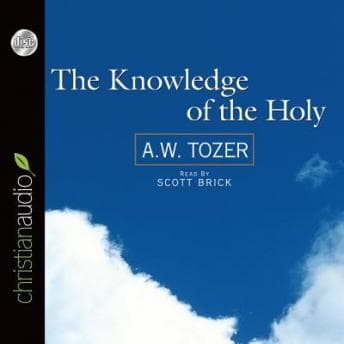
A.W. Tozer didn't have credentials. No seminary degree, no doctorate, no letters after his name. What he had was a mind that wouldn't quit wrestling with the biggest questions a person can ask, and a pen sharp enough to pin those questions to the page. The Knowledge of the Holy is essentially twenty-three short chapters, each one examining a single attribute of God — His self-existence, His omniscience, His sovereignty, His faithfulness — and Tozer approaches each one like a man building a cathedral brick by brick. There's no filler. No anecdotes about his neighbor's dog to lighten the mood. Just concentrated theological thought delivered in prose that somehow manages to be both austere and deeply moving.
This reminds me of what Hemingway said about prose being architecture, not interior decoration. Tozer builds. He doesn't decorate. Each chapter is maybe ten to fifteen minutes long, and they hit like individual sermons — which, in a sense, they were. The brevity is the point. You finish a chapter on God's immutability and your brain needs a minute before you can move on to His omnipresence. At four and a half hours total, this is a short listen by any measure, but don't let that fool you. The density per minute is extraordinary. I found myself rewinding constantly, not because I'd missed something but because I wanted to hear a particular formulation again.
My students would hate this. I love it.
Scott Brick Knows When to Get Out of the Way
Here's what Scott Brick understands about this material that a lesser narrator might not: the words are doing the heavy lifting. His delivery is measured and sober — almost austere, which mirrors Tozer's prose perfectly. There's no vocal gymnastics, no dramatic pauses engineered for effect. But — and this is crucial — he's not flat. There's warmth underneath the restraint. You can hear him leaning into certain phrases, giving just slightly more weight to a line like "What comes into our minds when we think about God is the most important thing about us." The narrator understands that pause is punctuation, and Brick uses silence the way a good musician uses rests.
No sound effects. No music. No production tricks. Just one voice and Tozer's words. For this particular book, that's exactly right. Anything else would have felt like putting a neon sign on a monastery.
The only thing I'd note — and this is genuinely minor — is that the straightforward, lecture-style delivery means there's nothing to grab you back if your attention drifts. I tried listening while grading papers one night around 11 PM and realized after twenty minutes that I'd absorbed absolutely none of it. This isn't a criticism of Brick. It's a criticism of me trying to split my attention with material that demands all of it.
Who Needs This (and Who Should Probably Pass)
Let me be honest: I came to this as an English teacher, not a theologian. I'm the guy who reads Augustine for the rhetoric and Aquinas for the logical structure. So when I say Tozer's prose deserves to be savored, I mean it on a purely literary level as much as a spiritual one. If you loved C.S. Lewis's Mere Christianity, this is its spiritual successor — or maybe its more serious older brother. Less wit, more weight.
But here's who should think twice: if you're looking for narrative, you won't find it. If you want stories, illustrations, modern applications — Tozer isn't interested. He's writing for people who want to sit with ideas, not be entertained by them. And if you're not coming from a Christian framework, large portions of this will feel like someone explaining the rules of a game you're not playing. That's not a flaw in the book. It's just the reality of its audience.
For believers who feel like their understanding of God has gotten shallow — domesticated, maybe — this is a corrective. A bracing one. Rachel Held Evans was wrestling with a different kind of spiritual disorientation in Searching For Sunday — less about recovering God's majesty and more about recovering a reason to stay in the room at all, but the hunger underneath both books feels like the same thing.
Worth Pausing the Faculty Meeting For
I finished this on a Saturday morning, sitting on the back porch with coffee going cold. Four and a half hours is nothing in terms of time. But I've been thinking about it for days. Tozer wrote this in 1961, and the opening chapter — where he argues that the church has lost its sense of God's majesty — reads like it could have been written yesterday. This is why we still read the classics, even the ones that aren't technically classified as literature. Some books don't age because the questions they're asking never get answered. They just get deeper.
The prose deserves to be savored. Listen at 1.0x. I'm not negotiating on this one.