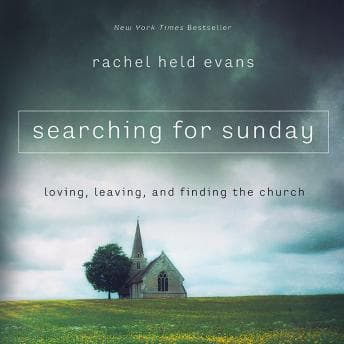

I have a bone to pick with Rachel Held Evans. She keeps articulating the exact spiritual crisis I've been circling for years, and she does it with this infuriating clarity that makes my own attempts at processing feel like incoherent rambling. I was chopping onions for a dal that would take three hours and feed me for a week, tears already streaming (the onions, sure, let's say it was the onions), when she described leaving a church she genuinely loved. Not a toxic church. A kind one. And I had to put down the knife because—psychologically, this doesn't track with the narrative we tell ourselves about church departures, right? We want the clean story: bad church, brave exit, healing. Evans refuses to give us that simplicity.
This is a fascinating case study in what happens when someone deconstructs their faith without destroying it. The research actually shows that identity disruption—which is exactly what leaving a religious community represents—typically follows predictable patterns. POSITIVE THINKING POWER tries to address this kind of identity crisis, though with far less nuance. Denial, bargaining, the whole grief cycle applied to belief systems. Evans knows this intuitively. She structures the entire book around the seven sacraments, which is such a clever psychological move. She's not abandoning the framework; she's excavating it. It's the opposite approach from something like Practical Guide to Self-Hypnosis, which wants you to bypass the framework entirely and rewire from scratch. Finding what's still alive underneath the institutional debris.
The Protagonist Exhibits Classic Ambivalent Attachment
What makes Evans compelling as a narrator—and I mean this both in the storytelling sense and the literal audiobook sense—is that she reads her own work. This matters enormously. There's a moment where she describes a Gay Christian Network conference, and her voice catches slightly on the word "healing." You can hear the memory in her throat. A professional narrator might have smoothed that over. Evans lets it stay rough.
Her writing has this quality I keep calling "poetic honesty" in my notes, which sounds pretentious but I can't find a better term. She'll hit you with imagery that belongs in literary fiction—the way she describes communion as "God's love made edible"—and then immediately follow it with something so plainly confessional you feel like you're eavesdropping. The shifts are jarring in the best way. My therapist would have thoughts about this character, except Evans isn't a character. She's just... uncomfortably transparent about her own contradictions.
Why This Book Made Me Angry (In a Good Way)
I study why people do what they do. That's my whole thing. And Evans kept forcing me to confront my own cynicism about organized religion. I grew up watching my parents navigate their Hindu faith in suburban New Jersey, surrounded by churches that seemed to view them as either conversion projects or exotic curiosities. So I have my biases. Evans addresses church hypocrisy, the scandals, the gargantuan building budgets—she's not naive. But she also refuses to let cynicism be the final word.
There's this section on confession that hit differently while I was on a morning jog through Cambridge, trying to outrun my own unfinished dissertation chapter. She talks about the relief of being known, fully known, and not being abandoned for it. The human need for that kind of witness. I found myself asking: why does this speak so specifically to someone who hasn't set foot in a church in years? Because she's not really writing about church. She's writing about the terrifying vulnerability of belonging anywhere.
The seven sacraments structure works beautifully as an organizing principle. Baptism, communion, confirmation, confession, marriage, anointing of the sick, holy orders—each becomes a lens for examining different aspects of community and meaning-making. It's memoir meets theological reflection meets (honestly) group therapy transcript. At seven and a half hours, it's a substantial listen, but the pacing never dragged for me. Evans knows when to go deep and when to surface for air.
Who Should Stream This (And Who Should Maybe Not)
If you've ever left a faith community—or stayed in one while feeling increasingly like a stranger—this book will find you. If you're looking for a systematic theology or a takedown of institutional Christianity, look elsewhere. Evans isn't interested in being right. She's interested in being honest, which is much more dangerous.
People who need clear answers will find this frustrating. Evans lives in questions. She's comfortable with ambiguity in a way that might read as wishy-washy if you're looking for doctrinal certainty. But for those of us who've been trained to analyze human motivation—the research actually shows that tolerance for ambiguity correlates with psychological flexibility—her approach feels refreshingly mature.
Content note: she discusses LGBTQ inclusion in the church extensively and with obvious advocacy. If that's going to be a problem for you, you'll know within the first hour.
Closing the Case File
Rachel Held Evans died in 2019 at thirty-seven. I didn't know this when I started listening. Knowing it now makes certain passages land with unbearable weight—her writing about death, about the anointing of the sick, about what we leave behind. She wrote about finding church again, and then she left it in the most permanent way possible.
I'm not a religious person. But I finished this book understanding something I hadn't before: that the hunger for sacred community isn't weakness or delusion. It's just... human. Evans articulated the thing I couldn't. And I'm still a little annoyed about it.









