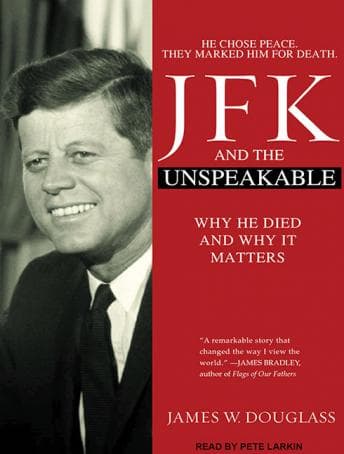

Twenty-two hours and twenty-five minutes. That's the commitment Douglass is asking for, and I'm going to tell you upfront: it's worth almost every minute.
I started this one on a red-eye to Chicago, couldn't sleep, figured I'd knock out a few chapters. Landed five hours later having not closed my eyes once. Not because of turbulence - because Douglass builds his case the way a McKinsey partner builds a board presentation. Layer by layer, source by source, until the weight of evidence becomes its own argument.
This Is Not Your Uncle's Conspiracy Book
Let me get this out of the way. When someone says "JFK conspiracy," your brain probably goes to Oliver Stone, grainy footage, guys in trench coats. I get it. Mine did too. But Douglass is a peace activist and theologian, not a filmmaker, and the difference shows. He's not trying to give you a thriller. He's trying to give you a legal brief.
The Cuban Missile Crisis sections alone are worth the listen. Douglass puts you inside the room where Kennedy is getting hammered by the Joint Chiefs to authorize a first strike, and you feel the pressure of men who genuinely believed nuclear war was winnable. Kennedy's shift from Cold Warrior to peace advocate isn't presented as some saintly conversion - it's shown as a practical, terrified response from a guy who looked into the abyss and flinched. That felt real to me. That's what my parents would've done. You see the bill, you adjust the business plan.
The Oswald material is where things get dense. Douglass traces Oswald's movements through the Soviet Union, New Orleans, Mexico City - connecting handlers, intelligence contacts, and convenient coincidences with the patience of an accountant doing a forensic audit. Some of it is devastating. Some of it requires you to hold a lot of threads simultaneously, which at 22 hours is genuinely difficult even at 2.0x speed.
Where the ROI Gets Complicated
Here's my honest assessment: there are probably 14 hours of essential content in this 22-hour book. Douglass repeats his thesis - that Kennedy's turn toward peace made him a target for what Thomas Merton called "the Unspeakable" - so many times that by hour 15, you're nodding along going "yes, I know, the military-industrial complex didn't like him, we've covered this."
But then he'll hit you with something specific - like the story of a Chicago assassination plot against JFK just weeks before Dallas that got quietly swept away, or the strange case of Richard Case Nagell, who claimed he was ordered to kill Oswald before Oswald could be used as a patsy - and suddenly the repetition feels like necessary scaffolding.
Pete Larkin narrates with a steady, slightly sardonic delivery that's exactly right for this material. He's not trying to dramatize it. He reads Douglass's prose like a news anchor who's quietly furious, which - given the content - is appropriate. His low-key approach to characterizing the principals (Kennedy, Khrushchev, the various intelligence figures) keeps this grounded as nonfiction rather than drifting into docudrama territory. Smart choice. At 22 hours, a more theatrical narrator would've been exhausting.
Who Should Block Out a Weekend For This
If you're the type who reads the footnotes - and Douglass has mountains of them - this is your book. If you've read Taleb or studied institutional incentive structures, the framework here will feel familiar: organizations optimizing for their own survival at the expense of their stated mission. Five Presidents covers some of this same institutional machinery from the inside — a Secret Service agent watching five administrations navigate exactly these kinds of survival pressures, though with considerably less theological scaffolding. I've seen this fail at three different companies, except in those cases nobody got assassinated. (Usually.)
If you want a tight, fast-moving JFK narrative, this isn't it. This is the 400-page appendix that other JFK books reference. It's exhaustive by design.
Skip this if you need your history served in Netflix-episode chunks. This is a graduate seminar, not a documentary.
The Consulting Engagement Is Over - Here's the Deliverable
Bottom line: Douglass wrote something that's simultaneously too long and impossibly important. The key takeaway is worth the listen. The other 7 hours? Not so much. But those core 14-15 hours changed how I think about institutional power, and that's not something I say often. My parents ran a dry cleaning shop and understood intuitively that power protects itself - they just didn't have 800 footnotes to prove it.
Jenny asked me what I was listening to and I tried to explain it over dinner. Forty-five minutes later she said, "So the government killed Kennedy?" And I said, "It's more complicated than that." And she said, "It always is with you." She's not wrong.





![Steve Jobs [unabridged audiobook] audiobook cover](/_next/image?url=https%3A%2F%2Fcovers.audiobooks.com%2Fimages%2Fcovers%2Ffull%2F9788499923406.jpg&w=1920&q=75)