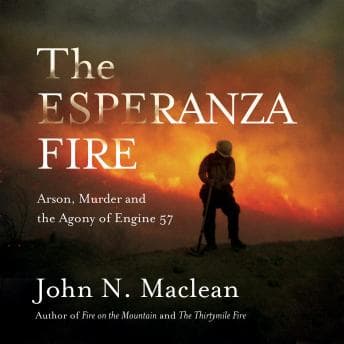

So here's the thing — I expected this to be a standard true crime wildfire book. Like, arsonist sets fire, firefighters die, courtroom drama, fade to black. And structurally? That's exactly what it is. But I was not prepared for how methodical and devastating the actual fire mechanics would be, and how John Maclean's engineering-brain approach to documenting what happened to Engine 57 would wreck me on a Tuesday morning commute.
I'll be upfront: I picked this up because I'd just finished a sci-fi trilogy and needed something grounded. Real-world. Something where the stakes were tangible. Be careful what you wish for. The last time a nonfiction book ambushed me this hard coming off genre fiction was Isaac Newton — Gleick's biography reads like a thriller but is just... relentlessly, uncomfortably real about how a human brain actually works at that level.
The Part Where Physics Kills People
Maclean is the son of Norman Maclean (yes, that Maclean — Young Men and Fire), and you can feel the DNA here. He doesn't just describe the Esperanza fire; he reverse-engineers it like a postmortem on a production incident. The "area ignition" that killed the crew of Engine 57 — where fire erupted across three-quarters of a mile in seconds — gets broken down with the kind of precision I use when writing incident reports. Wind speed, terrain angle, fuel moisture content, the thermal dynamics of superheated gases hitting a house on a hillside. The science actually holds up. And that's what makes it horrifying. Because you understand exactly why five people died, and you understand that given the same inputs, the same thing would happen every time. There's no randomness here. Just physics and bad positioning and a serial arsonist named Raymond Lee Oyler.
The moment that hit hardest: Maclean walks you through the crew's final radio communications, then maps their positions relative to the fire's advance. You can calculate in your head that they had maybe 30 seconds between "this is getting bad" and "there is no escape." I actually stopped walking from the Caltrain station and just stood on the sidewalk for a minute.
Raymond Lee Oyler and the Voice Pete Larkin Gives Him
Here's where the audiobook earns its format. Pete Larkin makes a choice with Oyler that I found initially annoying and then increasingly effective. He gives Oyler this slightly flat, dumbed-down voice — not cartoonish, but distinctly less sharp than everyone else in the room. During the courtroom scenes, the contrast between the prosecutors' measured legal language and Oyler's affect is stark. It's a performance choice that could've gone wrong but actually mirrors how multiple people described Oyler: unremarkable, not particularly bright, the kind of guy you'd forget meeting.
Larkin's straight narration is solid if unspectacular. He's not Ray Porter (nobody is, fight me), but he handles the technical fire behavior sections without making them sound like a textbook, and he keeps the courtroom pacing tight enough that I didn't zone out during legal procedural stretches. For a 10-hour single-narrator production with no sound effects or music, that's not nothing.
The courtroom scenes themselves are genuinely interesting because of the legal precedent involved — charging an arsonist with first-degree murder for firefighter deaths. Maclean clearly spent those five years of research in the courtroom, because the trial coverage reads like someone who was taking notes in real-time, not reconstructing from transcripts.
Where It Drags (And Where That's the Point)
Look, I'll be honest — the middle third sags. Maclean goes deep on Oyler's history of setting fires along the Banning Pass, and while it's important for establishing the prosecution's pattern-of-behavior case, it gets repetitive. Fire here, fire there, witnesses who saw a white van. I bumped to 1.5x for about two hours and didn't miss anything critical.
But then the trial's conclusion hits, and Maclean earns back every slow minute. I won't spoil it, but "stunning conclusion" in the book description is underselling it. The jury's deliberation and the sentencing — the way Maclean handles the families of the Engine 57 crew in those final chapters — that's where the book transforms from journalism into something that actually hurts.
Perfect For: Commute, Roadtrip. Skip For: Background Noise.
This is not a half-attention book. The fire science sections require your brain to be online, and the emotional weight of the crew's deaths deserves more than absent-minded listening while you're cooking. I'd say commute works if you're alert enough — I listened to the first half on morning trains and caught everything — but don't queue this up while debugging. You'll either miss the details or you'll miss a bug. Either way, something burns.
If you've read Maclean's earlier books or you're into wildfire science (shoutout to anyone who watched that Cal Fire documentary), the ROI on this audiobook is high. If you're coming from true crime and expecting a serial killer thriller... calibrate expectations. This is methodical, investigative, and deeply empathetic toward the firefighters. The villain is almost secondary to the fire itself.
Push to Prod
TL;DR: Worth your commute. A meticulous, sometimes slow, ultimately devastating account of the Esperanza fire that earns its emotional payload through scientific precision rather than melodrama. Pete Larkin is a competent guide, if not a transcendent one. I finished this in about 5 commutes at mixed speed, and I'm still thinking about those last radio transmissions a week later.






![Steve Jobs [unabridged audiobook] audiobook cover](/_next/image?url=https%3A%2F%2Fcovers.audiobooks.com%2Fimages%2Fcovers%2Ffull%2F9788499923406.jpg&w=1920&q=75)