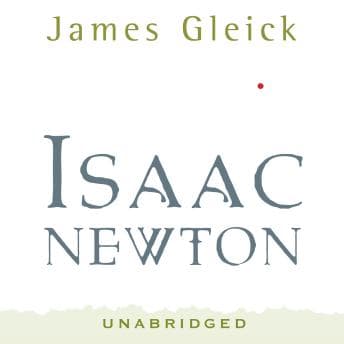

James Gleick doesn't write biographies. He writes intellectual portraits. And this one - at just under six hours - is exactly the kind of dense, beautiful thing I wish more science writers would attempt.
I finished this walking the lakefront last Tuesday, wind coming off Lake Michigan, Denise texting me about dinner plans I was absolutely ignoring. Newton was having a breakdown about priority disputes with Leibniz over calculus, and I was thinking about how some of the pettiest feuds in history have produced the most consequential ideas. This is why we still read about these people. Not because they were saints. Because they were complicated, difficult, sometimes impossible humans who happened to reshape how we understand everything.
The Mind Behind the Math
Gleick does something here that I try to teach my students about literary biography - he doesn't separate the work from the person. Newton's rage, his paranoia, his obsessive secrecy, his weird alchemical experiments - they're not footnotes to his physics. They're part of the same brain that saw an apple fall and asked why. (Yes, the apple story is probably apocryphal. Gleick handles this with appropriate skepticism.)
The prose is tight. Gleick has given us the man and his mind in their full craziness - and I'm borrowing that phrase because it's exactly right. He doesn't waste words. Every sentence earns its place. My students would hate this. I love it.
Here's the thing, though. This isn't pop science. If you're expecting a breezy "Newton for Dummies" experience, you're going to struggle. Gleick assumes you're willing to work a little. The calculus explanations, the optics debates, the theological tangents - they require attention. I had to rewind sections twice. Once because I genuinely didn't follow, once because the prose deserved to be savored.
Why Allan Corduner Works
The narrator understands that pause is punctuation. Corduner's British accent isn't just atmospheric - it feels historically appropriate in a way I can't quite articulate. There's something about hearing Newton's letters read in that cool, measured voice that makes the material feel less like a textbook and more like a conversation across centuries.
He handles the technical passages without rushing them, which matters enormously. Bad science narration either races through equations like they're embarrassing or over-enunciates them like you're a child. Corduner finds the middle ground. He trusts you to keep up while giving you room to breathe.
I couldn't find much about Corduner's other work online, but based on this performance, the man knows how to inhabit intellectual material. The emotional register shifts when Newton's personal life darkens - the feuds, the isolation, the strange late-life obsessions with biblical chronology. Worth pausing the faculty meeting for. (Principal Martinez, I was definitely paying attention to your budget presentation. I wasn't.)
Where It Gets Difficult
Look, I need to be honest. If you don't have at least some interest in the history of ideas - not just science, but how knowledge gets made and fought over - parts of this will feel like homework. The book lacks a strong narrative through-line in the traditional sense. It's not a story with rising action and climax. It's a portrait, built in layers.
This reminds me of what Hemingway said about writing - that you could omit things if you knew them, and the omitted part would strengthen the story. Gleick knows so much that what he leaves out is almost as interesting as what he includes. That same restraint—knowing what to hide—shows up in Secret Empires, though Schweizer's investigating a very different kind of hidden structure. But that approach requires a reader (or listener) who's willing to meet him halfway.
My wife asked me what it was about when I finished. I said, "A man who invented physics and spent twenty years trying to destroy another mathematician's reputation." She said, "So, academia." She's not wrong.
The Takeaway
At five hours and forty-six minutes, this is lean for a biography of someone this significant. Gleick could have written eight hundred pages. He wrote something closer to three hundred. The restraint is part of the point. Newton himself was obsessed with hidden forces, invisible structures beneath visible phenomena. Gleick's biography operates the same way - compact on the surface, deep underneath.
If you loved Gleick's Chaos or Genius, this is its spiritual successor - tighter, maybe more personal. If you've never read Gleick, this is actually a decent place to start, assuming you're not scared of thinking hard while you listen.
Who should listen: History-of-science nerds, anyone who wants Newton the human rather than Newton the monument, and readers who appreciate prose that doesn't hold your hand. Who should skip: If you need a clear narrative arc or find intellectual history tedious, this will frustrate you.
I'm recommending this to my AP Lit students. They'll complain. They'll thank me later. That's usually how it works.