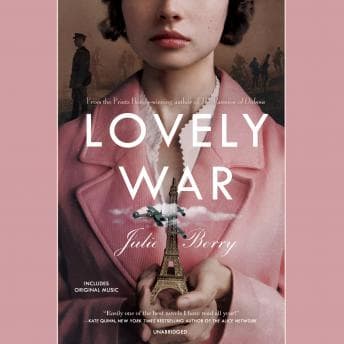

Can a love story actually compete with a world war? Like, literally compete—as in, gods placing bets on whether romance or destruction wins? That's the premise Julie Berry hands us, and honestly? I wasn't sure it would work. But I finished this one during three consecutive nap times (Sophie actually cooperated, bless her), and I'm still thinking about it.
Here's the setup: Aphrodite is on trial. Hephaestus has caught her with Ares (again), and instead of the expected divine drama, she launches into this sprawling story about four mortals during World War I. It's her defense—proof that love matters, that it's worth fighting for even when the world is literally on fire. The framing device sounds gimmicky on paper, but something about hearing Jayne Entwistle's Aphrodite—all certainty and ancient wisdom wrapped in a voice that sounds like she's been watching humans mess things up for millennia—makes it work.
When Eight Narrators Actually Make Sense
Okay, so eight narrators sounds like chaos. I went in expecting to spend half my car time trying to figure out who was talking. But this is one of those rare full-cast productions where the casting is so intentional that you never lose the thread.
Fiona Hardingham captures Hazel's innocence—she's this young pianist falling in love right before everything goes to hell, and Hardingham makes her vulnerability feel earned rather than naive. Then you've got Dion Graham voicing Aubrey, a Black ragtime musician from Harlem serving in a segregated army, and his sections hit different. The way he delivers Aubrey's experiences with racism in the military—there's this controlled fury underneath the words that made me grip my steering wheel.
Allan Corduner gets the Greek gods and several male characters, and "darkly delicious" is apparently how reviewers describe his work, which... yeah, that tracks. There's something almost theatrical about his delivery that fits the mythology framing without feeling over the top.
The Complexity Problem (And Why I'm Torn)
Here's where I get honest: this book asks a lot. There are two love stories weaving through WWI, Greek gods interrupting to comment on everything, and Julie Berry's writing is genuinely lyrical—the kind of prose that rewards attention. Some listeners have said the complexity works better on the page, and I get that. There were moments during school drop-off when I'd zone out for thirty seconds (Lucas was asking why squirrels don't go to school, as one does) and I'd come back having missed a crucial thread.
At 13 hours, this isn't a quick listen. The romance between Hazel and James builds slowly—some might say too slowly. I've seen complaints that it "lacked momentum," that the love felt "distant." And I understand that criticism. This isn't a romance that punches you in the gut with immediate chemistry. It's quieter, more about longing and letters and the terrible weight of waiting for someone who might not come home.
But here's the thing—that pacing felt intentional to me. War is waiting. War is distance. The romance mirrors that reality.
Who This Is For (And Who Should Skip It)
If you want a fast, swoony romance you can half-listen to while scrubbing crayon off the walls? This isn't it. Skip it.
But if you want something that feels substantial—the kind of book that makes you think about love as an actual force in the world, about what it means to choose hope when everything is falling apart—this delivers. Fans of Divine Rivals will find similar DNA here (historical setting, war as backdrop, love as resistance). That same kind of sweeping, old-world romance shows up in Age of Innocence, though Wharton's war is entirely social. It's YA-adjacent but reads older.
I'd recommend focused listening. Not bedtime—you'll drift off and miss the mythology bits. Not background. This is car-time-in-the-garage material. The kind of book you save for when you need something that feels important.
Worth the Nap-Time Investment
Look, I didn't ugly-cry at pickup, but I came close during Aubrey's storyline. There's a moment where the book confronts what it meant to be a Black soldier fighting for a country that wouldn't serve you at a lunch counter, and Berry doesn't flinch from it. That alone makes this worth the listen.
The full-cast production elevates material that could have felt heavy in a single voice. The mythology framing gives you breathing room between the war's horrors. I got that same sense of breathing room from the dual timeline structure in Identicals: A Novel—different technique, same relief. And the ending—without spoiling it—actually earns its emotional payoff.
Not groundbreaking in the sense of reinventing anything. But sometimes you don't need groundbreaking. Sometimes you need a book that believes love matters, and makes you believe it too.