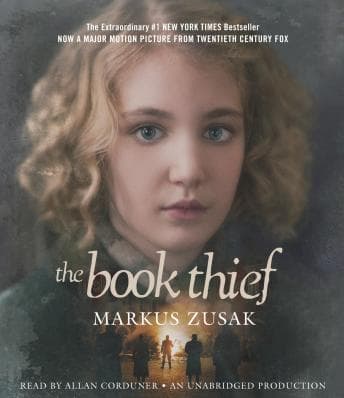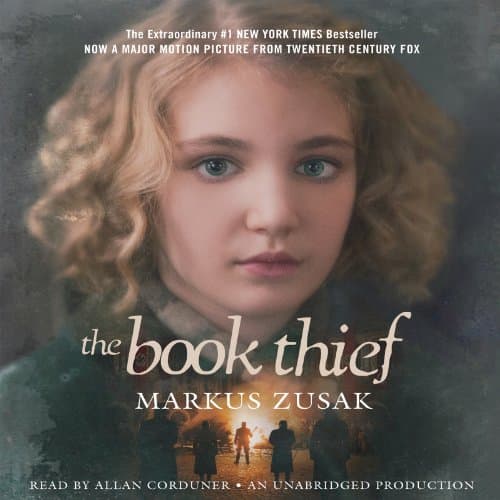

Death narrates this book. That sentence alone should tell you whether you're in or out. Markus Zusak made one of the boldest narrative choices in modern fiction by handing the storytelling reins to the Grim Reaper himself — not as a horror figure, but as a weary, sardonic, oddly compassionate observer of humanity at its worst and most beautiful. And Allan Corduner's performance makes that gamble pay off in ways the printed page simply cannot.
Set in Nazi Germany beginning in 1939, The Book Thief follows Liesel Meminger, a foster girl placed with Hans and Rosa Hubermann on Himmel Street outside Munich. Liesel's introduction to books begins at her brother's graveside, where she steals a manual accidentally dropped by a gravedigger. From that grim origin, her relationship with words and stories becomes a lifeline — for herself, for the Jewish man hidden in her basement, and for her neighbors huddled in bomb shelters while the world burns above them.
What separates this from the crowded field of World War II fiction is Zusak's prose style, which reads like poetry soaked in ash. Death interrupts the narrative with definitions, observations, and color descriptions that sound bizarre on paper but land with devastating precision in audio. When Death tells you the sky was the color of Jews, or pauses to catalog the souls collected on a particular day, you feel the weight of omniscience paired with exhaustion. Corduner captures this perfectly. His voice carries a melodic warmth that never tips into sentimentality, balanced with a dispassionate quality that reminds you: your narrator has seen everything, and none of it surprises him anymore.
Corduner's character work deserves special attention. He differentiates the entire cast with accents and vocal shifts that feel organic rather than theatrical. Hans Hubermann's quiet steadiness comes through in measured, gentle tones. Rosa's rough affection — she calls everyone a pig or worse — somehow becomes endearing rather than grating. Rudy Steiner's boyish energy practically bounces out of the speakers. And when Corduner voices Max Vandenburg, the Jewish fist-fighter hiding in the Hubermanns' basement, there's a fragility layered under defiance that hit me harder than I expected during a late-night listening session.
The structure of this book is unconventional. Death spoils major plot points early and often, telling you flat-out who will die before you've even grown attached to them. This should kill the tension. Instead, it amplifies everything. Knowing what's coming transforms every small moment of kindness, every shared book, every stolen apple into something unbearably precious. Zusak weaponizes dramatic irony in a way that few authors attempt and fewer pull off. In audiobook form, with Corduner's measured delivery, these spoilers land like gut punches wrapped in velvet.
I'll be honest about the pacing: the middle third of this nearly fourteen-hour listen can feel slow. Liesel's daily life on Himmel Street, the routines of school and neighborhood dynamics, the gradual unfolding of her literacy — it's deliberate and quiet. If you're coming off a fast-paced thriller, this stretch will test you. But Corduner's narration carries you through these passages the way Hans Hubermann's accordion carries the residents through air raids. The voice becomes the thing you hold onto.
The ending broke me. I won't say more than that, except that Zusak earns it. Every slow page in the middle, every quiet domestic scene, every moment of normalcy that felt unnecessary — it all pays off in the final hour with an emotional force that made me sit in my car for ten minutes after arriving home, staring at nothing. The comparisons to Anne Frank's diary aren't hyperbole. Both works achieve something similar: they make you feel the specific, individual cost of historical atrocity. That same reckoning with individual lives swallowed by enormous history is something I kept thinking about when I reviewed Count of Monte Cristo — a very different era and a very different kind of injustice, but that same insistence that one person's story matters against the sweep of brutal events.
Compared to Anthony Doerr's All the Light We Cannot See, which operates in a similar WWII space with lyrical prose, The Book Thief is warmer and more accessible. Doerr's novel is technically dazzling but can feel clinical. Zusak's feels like a conversation with someone who has lived too long and loved too much. Against something like The Boy in the Striped Pajamas, which tackles similar themes through childhood innocence, The Book Thief is more sophisticated and less reliant on a single narrative device.
This is a single-narrator performance with no music or sound effects, and it needs nothing else. Corduner's voice is the entire production, and it's enough. His ability to shift between Death's cosmic fatigue and Liesel's fierce small-world hunger for words creates a listening experience that justifies the audiobook format entirely. Some books are fine in print. This one is better spoken aloud.
Who Should Listen (And Who Should Skip): If you appreciate literary prose, unconventional narration, and WWII fiction that earns its emotional weight through patience rather than spectacle, this is essential listening. Skip it if you need a fast-moving plot or can't tolerate a narrator who tells you the ending before you get there — that structural choice is non-negotiable, and it'll either work for you or drive you up the wall.
If you give it the attention it demands — and it does demand attention, this is not background listening — The Book Thief will leave a mark. The kind you don't wash off.