
What happens when a guy who spent his entire career building the machine turns around and says the machine was broken the whole time?
I was up late finishing a deck for a Series B startup - the kind of night where you're on your fourth coffee and questioning every career decision you've ever made - when I put this on. And honestly, Stevens' particular brand of professional self-flagellation felt right at home with the mood.
The Insider's Confession That Doesn't Quite Confess Enough
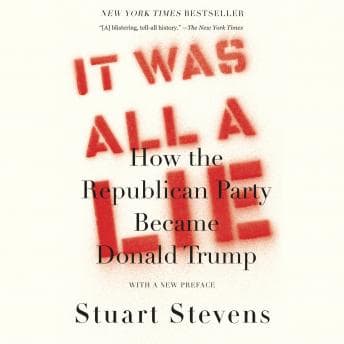
Stuart Stevens ran Mitt Romney's 2012 presidential campaign. Let that sink in. This isn't some pundit who watched from the sidelines and now has opinions. This is a guy who was in the room, running the plays, for decades. The insider-who-watched-history-happen angle reminds me of Five Presidents, though that one carries far less self-recrimination and far more reverence for the machinery of power. And his central argument is pretty brutal: Trump didn't hijack the Republican Party. Trump is the Republican Party. The racism, the fiscal hypocrisy, the family values theater - Stevens argues it was all baked in from the moment Goldwater opposed the Civil Rights Act.
Here's what makes this worth your time at 5 hours and 44 minutes: Stevens doesn't build some elaborate theoretical framework. He just... walks you through it. Goldwater. Nixon's Southern Strategy. Reagan's "welfare queens" and "states' rights" speeches in Philadelphia, Mississippi. The through-line he draws from the '60s to Trump's escalator ride is damning precisely because it's so straightforward. This is what my parents did instinctively - pattern recognition from lived experience. Now it has a TED talk. Or in this case, a Random House deal.
But here's where I get stuck. Stevens spent decades electing these people. He was a senior strategist for George W. Bush. He helped build the very apparatus he's now calling a pack of lies. And while he acknowledges this - there's real exasperation in the text, you can feel the guy wrestling with his own complicity - he never quite lands the plane on his own accountability. It's like a McKinsey partner writing a tell-all about how consulting destroys companies. Yeah, I'd know. I'd also need to own my part more than Stevens does here.
Dan John Miller Does Exactly What This Book Needs
The narration is a smart match. Miller reads this with a matter-of-fact delivery that lets Stevens' arguments carry their own weight. No dramatic pauses for effect, no breathless outrage voice. When Stevens is cataloging the party's contradictions - championing deficit reduction while blowing up the national debt under every Republican president since Reagan - Miller's tone carries this dry exasperation that feels earned, not performed.
It's not a flashy performance. There are no characters to voice, no dramatic scenes to act out. This is straight political argument delivered cleanly. And at under six hours, the ratio of insight to padding is actually pretty good. Finally, a business book - well, political book - that respects your time. I listened at 1.75x (slightly slower than my usual 2.0x because the political data comes fast) and it worked perfectly.
Who This Actually Serves
Here's the thing nobody's saying: this book is mostly preaching to the choir. If you already believe the GOP has been running on coded racial appeals since the '60s, Stevens gives you an insider confirming your suspicions. That has value - it's different hearing "yes, we knew exactly what we were doing" from someone who was doing it. But if you're a committed Republican, you'll dismiss this as a bitter ex-operative settling scores. And you won't be entirely wrong.
The people who should genuinely listen are the ones in the middle - the folks who remember when "fiscal conservative, socially moderate" was a real position. Stevens makes a strong case that this was always more marketing than reality, and that's an argument worth sitting with whether you agree or not.
I've seen this dynamic play out in corporate consulting too. Companies that build their brand on values they don't actually practice? Eventually someone walks into the room who doesn't even bother pretending. And everyone acts shocked. Stevens is saying: don't act shocked.
The ROI Calculation
Bottom line: Under six hours, genuine insider perspective, competent narration. The book is strongest when Stevens is specific - tracing exact policy positions, naming names, connecting dots between decades of campaign strategy. It's weakest when he drifts into broader cultural criticism that any op-ed writer could produce.
Skip to chapter 5 if you already know the Goldwater-to-Nixon-to-Reagan pipeline. Thank me later. The real value is in Stevens' firsthand accounts of how campaigns actually operated behind closed doors - the gap between what they said publicly and what they knew privately. That's the stuff you can't get from a history book.
Jenny would say I'm being harsh on Stevens for not owning his role more. Jenny is right. But I also think the book is worth the listen precisely because imperfect confessions are more interesting than clean ones. A consultant who says "I helped build something I now regret" is more useful than one who pretends they always knew better.







![Steve Jobs [unabridged audiobook] audiobook cover](/_next/image?url=https%3A%2F%2Fcovers.audiobooks.com%2Fimages%2Fcovers%2Ffull%2F9788499923406.jpg&w=1920&q=75)