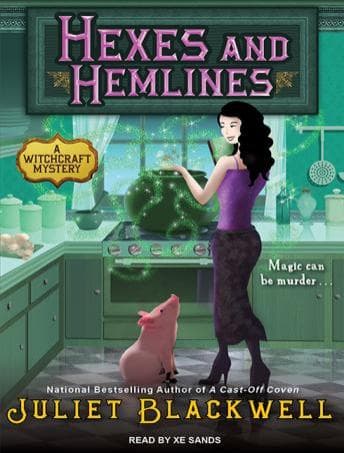

I was making aloo gobi at 10 PM on a Tuesday—don't ask why, insomnia is a lifestyle at this point—when Oscar the gargoyle-pig made me laugh so hard I nearly burned the cauliflower. That's the kind of book this is. Hexes and Hemlines snuck up on me.
Look, I picked this up expecting standard cozy mystery fare. Quirky protagonist, cute shop, murder that somehow doesn't feel too murdery. And yes, it delivers that. But Juliet Blackwell does something I genuinely appreciate: she writes a witch protagonist who thinks like someone who actually understands power dynamics and consequences. Lily Ivory isn't just "ooh magic sparkles"—she's cautious, aware of what her abilities cost, navigating a world that doesn't quite trust her. Classic outsider psychology, and Blackwell gets the internal conflict right.
When Superstitions Become Crime Scene Evidence
The setup here is delicious from a psychological standpoint. A rationalist society leader—someone devoted to debunking superstitions—gets murdered surrounded by every bad luck symbol imaginable. Broken mirror, black cat, the number thirteen, a ladder. It's almost theatrical. And that's what hooked me.
This is a fascinating case study in how we construct meaning around death. Did the killer stage this as mockery? As genuine belief in hexes? As misdirection? The psychological manipulation of belief systems shows up differently in Good Samaritan, where the killer's motivations are equally layered.
Blackwell doesn't rush the reveal, which I appreciated. The mystery unfolds through Lily's vintage clothing shop connections (the psychometry angle—sensing vibrations from objects—is genuinely clever), her complicated relationship with the local witch community, and her friendship with a suspect from the Serpentarian Society. Research actually shows that people who work with objects professionally often develop strong intuitive responses to them. Blackwell takes that kernel of truth and runs with it into supernatural territory, but the foundation feels grounded.
I will say—and my therapist would have thoughts about this—the plot gets a bit convoluted in the middle. There are a lot of characters, a lot of magical factions, and moments where I had to rewind because I'd lost track of who belonged to which society. For a cozy mystery, it's pretty dense. Not a dealbreaker, but if you're looking for something truly light, this requires more attention than your average beach read.
Xe Sands and the Art of Voicing a Gargoyle-Pig
Xe Sands. Okay. Here's the thing—she's divisive, and I get why, but I'm firmly in the "she nailed it" camp.
Her Lily is warm without being saccharine, curious without being naive. But what really sold me was Oscar. This gargoyle-turned-pig familiar could have been insufferable. Comic relief characters in paranormal cozies often are. Instead, Sands gives him this perfect blend of grumpy and endearing that made him feel like an actual character rather than a gimmick. One listener quote stuck with me: Oscar is "the most charming and endearing" character as Sands performs him. Accurate.
Now, I'll be honest—some of the accent work is... a choice. There were moments where secondary characters had voices that felt a little breathy or swallowed, and I can see how that would irritate some listeners. It didn't bother me much, but I was also chopping onions for half of this, so my attention was split. If you're sensitive to quirky narrator choices, maybe sample first.
The pacing is solid. Seven and a half hours flew by across maybe four cooking sessions and two morning jogs. Sands has this way of maintaining narrative momentum even during exposition-heavy sections—she doesn't let you drift. That's a skill.
Who Gets Hexed (In a Good Way) and Who Should Walk Away
If you're a fan of paranormal cozies and you haven't tried this series, what are you doing? Seriously. It's like catnip for the "witchy vibes plus murder" crowd. The San Francisco setting is fun, the vintage clothing shop premise is genuinely charming, and Lily is the kind of protagonist you want to hang out with.
But—and I need to be real here—if you want your mysteries straightforward, this might frustrate you. The supernatural elements are woven throughout, not just window dressing. You need to buy into the magic system. You need to accept that evidence gathering involves psychic impressions and familiar consultations. If that sounds exhausting rather than fun, skip this one.
Also, there's a murder. Violence is mentioned. Dark witchcraft is a plot point. It's still cozy in tone, but the content isn't entirely fluffy.
The Psychology of Belonging Through Usefulness
I found myself asking: why does Lily really keep getting pulled into these investigations? The answer the book gives is practical—she's a witch, the cops need witch expertise. But psychologically, there's something else going on. She's building community in a city where she's still an outsider. She's proving her value. She's finding belonging through usefulness. Let Me Go explores similar themes of protagonists proving themselves while navigating dangerous situations as outsiders. That's a character motivation I can get behind.
Would I continue the series? Yeah. I've already got the next one queued up. Oscar alone is worth the listen, and Sands makes the whole thing feel like being told a story by a friend who's really into witches and really good at voices. That's not nothing.