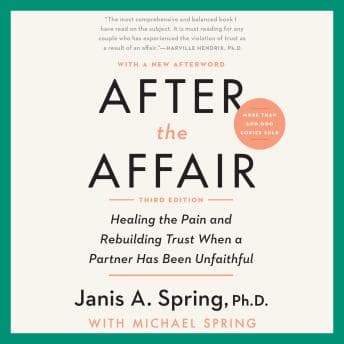

I wasn't going to review this one. Some books feel too personal to dissect publicly, and honestly, I picked this up for a client situation—a founder whose co-founder affair had blown up their startup and their marriage simultaneously. But three hours in, I realized I was taking notes for myself. Not because of any personal crisis, but because Spring's framework for understanding trust applies to every partnership I've ever consulted on.
Here's the thing about business books: they dance around the hard stuff. They give you frameworks and case studies and "learnings." Spring doesn't dance. She walks you through the psychological wreckage of betrayal with clinical precision—someone who's sat across from thousands of couples in crisis. And somehow, that clinical approach makes it more human, not less.
The Framework That Actually Works
Spring breaks healing into three distinct phases—normalizing the crisis, deciding whether to recommit, and rebuilding trust. What makes this different from the usual self-help padding is the specificity. She doesn't just say "communicate better." She gives you actual scripts. Actual questions to ask. Actual timelines for when certain conversations become possible.
The section on "low-cost behaviors" versus "high-cost behaviors" for earning back trust? That's the kind of concrete, actionable material I wish more business books had. Low-cost: being punctual, following through on small promises. High-cost: giving up friendships, changing jobs, accepting monitoring. She doesn't moralize about which is appropriate—she just lays out the menu and helps both partners understand what they're actually asking for.
I've seen this framework work in non-romantic contexts. A client whose business partner had been secretly negotiating a side deal used Spring's trust-rebuilding model almost verbatim. The "unfaithful partner" terminology felt weird in a boardroom, but the psychology was dead-on.
Xe Sands Earns Her Audible Credit
This is 9 hours and 20 minutes of heavy psychological material, and Sands delivers it without making you feel like you're in a lecture hall. Her pacing is deliberate—she slows down for the sections where you need to actually absorb what you're hearing. The case study sections, where Spring presents composite patient scenarios, benefit from Sands' ability to shift tone without doing character voices. You're never confused about whether you're hearing theory or application.
I listened at 1.5x instead of my usual 2.0x. Not because Sands couldn't handle the speed, but because the content demanded more processing time. This isn't background listening material. I tried it once during a routine email session and found myself completely missing paragraphs.
What My Parents Would Say
My parents' generation didn't have books like this. Affairs happened in their community—everyone knew, no one talked about it directly. The wives stayed or they didn't. There was no "healing framework." There was just survival.
Spring's approach would've seemed impossibly American to them—all this talking, all this processing, all this emphasis on individual feelings. And yet. The core insight—that betrayal shatters your sense of self, not just your relationship—that's universal. My mother would've understood that even if she'd never articulate it in Spring's clinical language.
The book doesn't promise reconciliation. It doesn't even particularly advocate for it. What it offers is a way to make the decision consciously rather than reactively. Stay or leave, but understand what you're choosing and why. That's the kind of clarity my parents achieved through decades of intuition. Spring gives you the shortcut.
Skip to Chapter 5 If You're Short on Time
The first four chapters are important context, but if you're in active crisis, Chapter 5's section on "What the Hurt Partner Needs" is where the practical guidance really kicks in. The new Q&A section in this third edition addresses questions that weren't covered before—including some uncomfortable ones about sexual intimacy that most books in this space avoid entirely.
Jenny would say I'm being clinical about something that deserves more emotional weight. Jenny is right. But I'm a consultant—I measure value by applicability. And this book has more applicable insights per hour than most business books I've reviewed this year.
Who Gets Value Here (And Who Won't)
Obviously, if you're dealing with infidelity—from either side—this is essential listening. But I'd also recommend it for therapists, mediators, and honestly, anyone who needs to understand how trust breaks and how it gets rebuilt. The principles transfer. Golden Key promises quick fixes—Spring refuses to play that game.
Skip it if you're looking for validation that your partner is simply terrible. Spring holds both parties accountable in ways that might feel uncomfortable if you need a villain.
Worth the Credit?
Nine hours is a significant commitment for a self-help book, but Spring respects your time. There's minimal repetition, no padding with celebrity anecdotes, and the case studies actually illuminate rather than just illustrate. Esther Perel's endorsement isn't just jacket copy—this is the book that serious practitioners recommend.
600,000 copies sold across three editions. That's not marketing. That's word of mouth from people who found something that worked when nothing else did.