
What happens when a woman decides the safest love is no love at all?
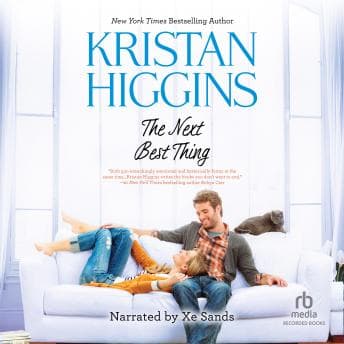
I'll be honest—I almost threw my phone across the room listening to this one. Lucy Lang made me want to reach through my earbuds and shake her by the shoulders. Here's a woman who has constructed an entire philosophy around emotional self-preservation after losing her husband young. She wants the lawn-mowing, chicken-grilling, soccer-coaching partner—but absolutely nothing that makes her pulse quicken. No fireworks. No passion. No risk of ever feeling that devastating loss again.
And so she pushes away Ethan Mirabelli. Hot, devoted, patient-as-a-saint Ethan. Her "friend with privileges" who clearly adores her. In favor of pursuing men who inspire approximately zero feelings.
I wanted to scream.
But here's the thing that kept me listening through every frustrating decision: Kristan Higgins isn't asking us to find Lucy likeable. She's asking us to find her real. And grief doesn't make people rational. Trauma doesn't produce tidy protagonists who make smart romantic choices. Ross Poldark explores that same messy reality—a man whose grief and trauma drive him to push away the people who could help him heal. Higgins wrote a woman who is genuinely terrified of loving again, and that fear manifests in ways that are maddening to witness—because that's exactly how grief works when you're living it.
Xe Sands Gets Inside Lucy's Walls
Xe Sands seems to understand this completely. Her narration walks a tightrope between honoring Lucy's emotional walls and letting us glimpse the vulnerability underneath. The warmth in her voice never quite disappears, even when Lucy is at her most infuriating. She finds the humor in Higgins' writing without undermining the genuine ache at the story's core. I found myself cleaning my entire apartment during one listening session, then sitting in my parked car for an extra twenty minutes because I couldn't bring myself to pause during a pivotal scene. That's the mark of a narrator who makes you want to keep listening even when the protagonist is testing your last nerve.
The character voices deserve special praise. Sands differentiates the cast—including the delightfully named Black Widows at the family bakery and the ever-patient Ethan—without resorting to cartoonish accents or jarring shifts. Her Ethan is particularly effective. She captures his steady, grounded presence in a way that made my heart ache for him. This man earns his happy ending, and Sands makes sure we feel every bit of his quiet devotion.
Stuck in Lucy's Head (For Better and Worse)
My one genuine frustration? We're locked inside Lucy's head the entire time. First-person narration means Ethan remains somewhat opaque, and I desperately wanted to know what was going on behind those patient eyes. There were moments when Lucy's internal monologue circled the same emotional territory repeatedly, and I found myself wishing I could escape into his perspective for just a chapter or two. This is a character study more than a dual-perspective romance, and your patience for that approach will determine a lot.
Higgins' writing style shines through Sands' delivery: witty, heartfelt, occasionally angsty, but never taking itself too seriously. The humor provides necessary relief from the heavier themes of grief and emotional avoidance. Fat Mikey the cat and the eccentric bakery regulars add levity without feeling like forced comic relief. It's the kind of balance that's made Higgins a bestselling author with RITA awards on her shelf.
The audio production is clean and professional—no technical issues to distract from the emotional journey. At just over ten and a half hours, the pacing feels appropriate, though if you're getting impatient with Lucy's avoidance patterns, bumping up to 1.25x speed might help.
Who Needs This Story (And Who Should Skip)
If you appreciate character-driven romance that doesn't shy away from emotional complexity, this delivers. If you've ever watched someone you care about sabotage their own happiness out of fear—or if you've been that person—Lucy's journey will hit differently. Commuters and multitaskers will appreciate how Sands' engaging delivery transforms mundane tasks into something almost enjoyable.
But if you need to like your protagonist from page one, or if first-person narration feels claustrophobic, this might not be your match. And if themes of grief and loss are difficult for you right now, approach with appropriate care.
My Heart Is Still a Little Bruised
Lucy Lang broke my heart even as she drove me crazy. Xe Sands made sure I felt every complicated moment of it. Sometimes the next best thing really is the real thing—you just have to get out of your own way long enough to see it.