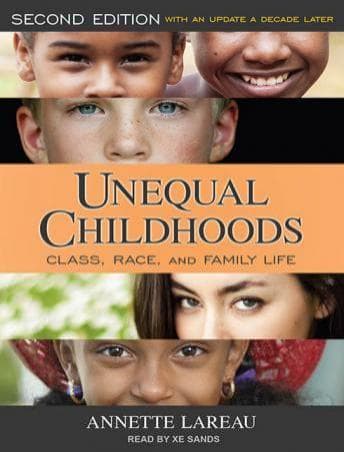

What if the way your parents raised you wasn't really a choice at all?
I was halfway through my Sunday meal prep—chopping onions for a dal that would feed me through the week—when this question hit me so hard I had to pause the audiobook. Lareau's framework had just clicked into place, and suddenly I was seeing my own childhood through an entirely different lens.
Social Science That Feels Like Intimate Portraiture
Lareau spent years embedded with twelve families across class and racial lines, and the result is something rare: research that reads like ethnography. She introduces us to Alexander Williams, a Black middle-class kid whose calendar rivals a corporate executive's—piano lessons, soccer practice, church choir. Then there's Harold McAllister, a Black working-class child who spends his summers playing outside with cousins, largely unsupervised, largely content.
The framework she develops—"concerted cultivation" versus "the accomplishment of natural growth"—is deceptively simple. Middle-class parents treat childhood as a project to be optimized. Working-class and poor parents provide love, stability, and space for kids to just... be kids. Neither approach is presented as morally superior, which I found refreshing. But Lareau is honest about outcomes: the cultivated kids learn to negotiate with authority figures, to question teachers, to advocate for themselves in ways that translate directly to institutional success.
I've studied these patterns in developmental psychology, but seeing them mapped across class lines rather than individual pathology? A fascinating case study in structural determinism.
Where My Therapist Would Have Thoughts
Here's what got under my skin. Lareau describes middle-class mothers who are exhausted, frazzled, constantly shuttling between activities—and she doesn't romanticize it. These families have resources but no time. Meanwhile, working-class families have time but constant financial anxiety. Neither group is winning, exactly. They're just losing differently.
The research shows something uncomfortable: working-class kids often have stronger extended family bonds and more genuine leisure time. But those same kids struggle to make eye contact with doctors, to challenge unfair grades, to navigate bureaucratic systems. The middle-class kids? They're exhausted little networkers by age ten, but they know how to work the system.
I kept asking: why does American society reward one parenting style so heavily when both produce functional, loved children? Lareau doesn't quite answer this—she's a sociologist, not a revolutionary—but she makes the question impossible to ignore.
The Decade-Later Update Changes Everything
The second edition includes follow-up interviews with the original children, now young adults. This is where the audiobook earns its fourteen-hour runtime. Alexander, the overscheduled middle-class kid? He's navigating college applications with parental coaching, internship connections, the whole apparatus of class reproduction. Harold, who had those idyllic unsupervised summers? He's working, struggling, still close to his family but without the institutional knowledge to translate his intelligence into credentials.
Psychologically, this tracks perfectly with everything we know about cultural capital and habitus. But hearing it in specific human stories rather than abstract theory—that's what makes this work land.
Xe Sands delivers the material clearly, though I'll be honest—this isn't a performance that demands attention. It's competent, steady, appropriate for academic material. She doesn't try to "do voices" for the different families, which is probably the right call. The book is dense enough without performative flourishes.
Who This Is Actually For (And Who Should Skip)
If you're a parent trying to figure out activities versus free play, this will either reassure or terrify you. Possibly both. If you're interested in class dynamics in America, this is foundational reading. If you're like me—someone who studies why people become who they become—Lareau offers a macro-level explanation that complements individual psychology beautifully.
Skip this if you want prescriptive advice. Lareau describes; she doesn't prescribe. Also skip if you need fast pacing. This is careful, methodical social science. I listened at 1.25x and it felt appropriate.
Still Thinking About This One
I finished the audiobook while folding laundry at 11 PM, thinking about my own parents—immigrants who somehow blended both approaches. Straight Shooter explores a similar tension between different worlds shaping one identity, though through the lens of sports rather than class. The structured expectations of my education, the unstructured hours spent with cousins during summer visits to India. Maybe that's why this book hit differently for me. I'm the product of both philosophies, and I can feel the tension between them still.
Lareau gave me language for something I'd intuited but couldn't articulate. That's worth fourteen hours. That's worth the discomfort of recognizing how much of who we become is shaped before we have any say in the matter.