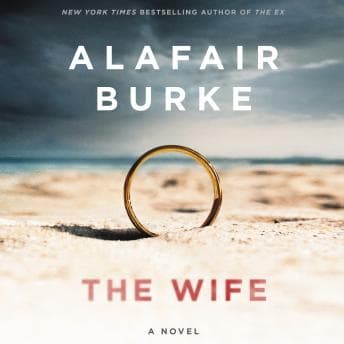

Alafair Burke used to be a prosecutor. A real one. She spent years in a DA's office handling domestic violence cases before she started writing fiction, and I want you to hold onto that fact for this entire review, because it matters.
I finished Wife on my drive home Tuesday morning after a particularly rough twelve hours. Nothing dramatic — just the slow grind of a unit that never fully quiets, paperwork that multiplies when you're not looking, and one family that needed more from me than I had left to give. I was forty minutes from my driveway and I needed something to pull me out of my own head. Wife did that job.
When A Former Prosecutor Writes A Legal Thriller, The Cops Actually Sound Like Cops
Here's what I keep running into with domestic suspense: the legal and procedural scaffolding is usually held together with duct tape and vibes. I sat through something similar with No One There — procedural bones that kept collapsing under the weight of choices no actual investigator would make, and a synthesized narrator that made the whole thing feel even more disconnected from anything real. Someone gets accused, the police immediately believe the worst possible interpretation of every piece of evidence, and the protagonist makes decisions that would get an actual person arrested for obstruction inside of forty-eight hours. Burke doesn't do that. The way the accusation against Jason unfolds — the intern first, then Kerry Lynch with the more serious allegation — it moves the way these things actually move. Slowly. With institutional ambiguity. With that maddening space where everyone knows something is wrong but the mechanism for proving it is grinding along at its own pace.
Angela's position is the part that got me. She's not just a wife defending a husband. She's a woman with a buried past who built a careful, quiet life, and now the spotlight her husband keeps dragging her toward is about to expose everything she's spent six years covering. The choice isn't really about Jason at all — it's about whether she sacrifices herself to protect a version of her life that was always a little precarious. That's a more interesting question than most domestic thrillers bother to ask.
The twist-upon-twist structure in the back half earns it. I'm not going to say more than that, but the ending sat with me past my exit.
Xe Sands: The Angela Problem
Okay, so here's where I have to be honest with you. Xe Sands won an AudioFile Earphones Award for this, and I can hear why — her Angela is flat and fragile in a way that's clearly intentional, this woman who has learned to make herself small. And her Jason is warm, almost professorial, which makes him dangerous in exactly the right way. The contrast is doing real narrative work.
But. The dialogue. Some of the back-and-forth exchanges — particularly the scenes where Angela is being interviewed or questioned — felt slightly off in a way I couldn't stop noticing. Not wrong enough to make me skip ahead, but wrong enough that I'd occasionally think, nobody talks like that, and I'd lose a beat of focus. It's a stylistic thing and I know other listeners loved it. I'm just telling you what I experienced at 7 AM on the 202.
The pacing in the procedural middle section also slows down in a way that's probably realistic — because real investigations do slow down — but if you're coming in expecting relentless momentum, there's a stretch around the midpoint where you're going to feel it. I didn't mind. I'm used to waiting for things to develop. But I'm flagging it.
Who Needs This And Who Should Keep Scrolling
If you've read The Ex and liked it, this is a stronger book. If you're a Tana French fan who also tolerates American settings, you'll probably find enough here to stay interested. If you work in healthcare, social work, law, or any field where you've watched institutions fail people in slow motion — you'll recognize the texture of what Burke is doing.
If you need a book that's sprinting from page one and never stops, this isn't it. If you find psychologically fragile female narrators exhausting rather than interesting, Xe Sands' choices are going to wear on you.
For me? Eight hours ten minutes, and I didn't want it to end. Carlos asked why I was sitting in the driveway for twenty minutes after I got home. I told him I was finishing something. He's been married to me long enough to know what that means.