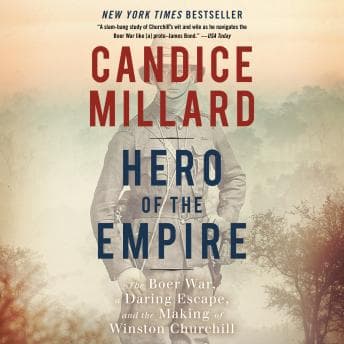

Twenty-four-year-old Winston Churchill showed up to a war zone with a valet and crates of vintage wine. I mean. The audacity.
I was elbow-deep in making pancit for my youngest's school potluck - 2 PM, just woke up from post-night-shift sleep, still groggy - when this detail hit me through my earbuds and I actually stopped stirring. Because I've met patients like this. Not the wine-and-valet part, but that absolute unshakeable conviction that they are the main character of the universe and nothing bad can really happen to them. In the ER, that attitude usually lands you on my unit. For Churchill, it landed him in a Boer prison camp and then catapulted him into history.
Four Slabs of Chocolate and Pure Nerve
Candice Millard does something I genuinely respect as someone who lives inside high-stakes situations for a living - she lets the facts do the heavy lifting. Churchill's escape from the Boer prisoner of war camp is wild enough without embellishment. The man crawled over a wall while guards were distracted, then had to cross hundreds of miles of enemy territory with cash, chocolate, and basically nothing else. No GPS, no backup plan, no extraction team. Just ego and luck.
And here's what got me: Millard doesn't just tell you Churchill was brave. She shows you the moments where he almost gave up. Where he was hiding in a mine shaft, terrified, surrounded by rats, and probably reconsidering every life choice that brought him there. That's the stuff I recognize. Bravery isn't the absence of fear - it's doing the thing while you're absolutely terrified. I see it in patients, in families, in the new nurses on my unit who haven't hardened yet. Millard gets this.
The historical details are meticulous without being dry. She weaves in Gandhi (yes, THAT Gandhi, who was also in South Africa during the Boer War as a stretcher bearer), Rudyard Kipling, Lord Kitchener - and none of it feels like name-dropping. It feels like what it was: a bunch of people who would later reshape the world, all bumping into each other before any of them knew what they'd become. My mom would love this. She's obsessed with historical "what if" moments. (She still thinks I should've been a doctor, but she'd definitely text me about this book.)
Simon Vance Did Not Come to Play
Okay. Simon Vance narrating a book about the British Empire is almost unfair. It's like asking me to start an IV - yeah, I'm going to nail it, because this is what I was built for. His British RP accent gives Churchill's world an authenticity that a different narrator would've had to fight for. But what impressed me is how he differentiates between classes and nationalities. The Boer soldiers sound distinct from the British officers who sound distinct from the Americans who pop up. He's not doing cartoon accents - there are subtle shifts in cadence, vowel weight, tone. You know who's talking.
The action sequences - the armored train ambush, the escape itself - Vance ratchets up the pacing without going melodramatic. He trusts the material. There's this full-throttle energy in his delivery during the tense moments that had me gripping my steering wheel on the drive home from shift one morning. (Carlos asked why I looked so wired when I walked in. I told him Winston Churchill almost got caught by a Boer patrol. He just nodded. He's used to this by now.)
At 10 hours and 15 minutes, the length is perfect. Enough to really sink into the history without that mid-book sag you get with longer biographies where the author clearly padded three chapters about someone's childhood.
Who's Going to Love This (and Who Should Probably Skip)
If you like narrative nonfiction that reads like a thriller - the kind where you forget these are real people who actually did these insane things - this is your book. If you've read Millard's other work (Destiny of the Republic, The River of Doubt), you already know she picks historical moments that feel almost too cinematic to be true, then proves they happened. Unbroken does the same thing with Louie Zamperini - real events so extreme your brain keeps insisting someone must have exaggerated, and yet.
Skip it if you want deep analysis of Boer War politics or a comprehensive Churchill biography. This is a specific slice of his life, not an encyclopedia. And honestly, young Churchill is kind of insufferable in his ambition and self-regard - Millard doesn't hide that, which I appreciate, but if you need to like your protagonist every second, fair warning.
Night Shift Approved, Dashboard Intact
I didn't yell at my dashboard once during this one. Not once. The historical details check out, the pacing respects your intelligence, and Simon Vance sounds like he was born to narrate stories about the British Empire at war. Perfect for that post-shift decompression when your brain needs something engaging enough to keep you awake on the drive home but structured enough that you don't miss plot points at red lights. This is the kind of audiobook that makes you show up to work and corner a coworker at the nurses' station: "Did you know Churchill escaped a POW camp with CHOCOLATE?" They didn't. Now they do.






![Steve Jobs [unabridged audiobook] audiobook cover](/_next/image?url=https%3A%2F%2Fcovers.audiobooks.com%2Fimages%2Fcovers%2Ffull%2F9788499923406.jpg&w=1920&q=75)