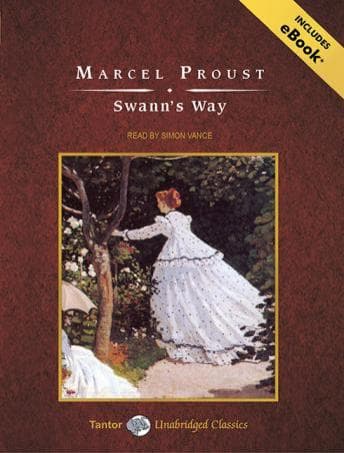

Look, I have a complaint. I've spent twenty years telling seventeen-year-olds that Proust is essential reading, and now - after seventeen and a half hours with Simon Vance in my ears - I realize I've been a fraud. Because I never actually experienced Proust until I heard him.
Let me explain. I read Swann's Way in graduate school. Dutifully. With a highlighter and a French dictionary and the kind of grim determination you bring to running a marathon in bad shoes. I understood it intellectually. I could write essays about involuntary memory and the madeleine and the way Proust collapses time like an accordion. But I didn't feel it. Not really. Not the way I felt it last Tuesday night, sitting alone on my back porch at midnight because Denise had gone to bed and I couldn't stop listening.
Proust Wrote Sentences That Shouldn't Work - Until You Hear Them Breathe
Here's the thing about Proust that nobody warns you about: his sentences are architectural. They're not long because he was undisciplined. They're long because he's building something - clause by clause, parenthetical by parenthetical - and the meaning doesn't arrive until the very end, when the whole structure suddenly holds weight. On the page, this can feel punishing. In your ears, with Simon Vance controlling the rhythm? It feels like watching a cathedral assemble itself in real time.
Vance gets this. He gets it. The narrator understands that pause is punctuation. He'll carry you through one of those fifty-word subordinate clauses about the quality of light falling on hawthorn blossoms near Combray, and you'll feel the grammatical tension building, and then he'll land the final phrase with this quiet precision that makes the whole sentence click shut like a lock. I actually whispered "yes" out loud during the passage about the steeples of Martinville. My neighbor's dog looked at me. I don't care.
And the madeleine scene - God, the madeleine scene. Everyone talks about it as if it's just a man eating a cookie and remembering stuff. It's not. It's Proust describing the physical sensation of a memory struggling to surface, the way it flickers and retreats and almost comes clear before dissolving again. Vance narrates this with a kind of breathless patience, like he's cupping something fragile in his hands. He doesn't rush the revelation. He lets you sit in the uncertainty the way Proust intended. The prose deserves to be savored, and Vance savors it.
Swann in Love, or: How to Make Jealousy Sound Like Opera
The middle section - "Swann in Love" - is where the book shifts from memory to obsession, and where Vance's character work gets genuinely impressive. Charles Swann's infatuation with Odette de Crécy is one of the most devastating portraits of romantic self-destruction in Western literature, and Vance plays it with this subtle arc from aristocratic composure to barely-concealed desperation. His Swann starts with a measured, almost bemused detachment - a man who thinks he's above being ruined by a woman who, as the narrator coolly observes, "was not even his type." By the time Swann is searching frantically through Parisian boulevards at night, Vance's voice has thinned, tightened. You hear the dignity evaporating.
His differentiation between characters is restrained but effective. The Verdurin salon scenes - all that vicious bourgeois gossip dressed up as intellectual conversation - get this slightly nasal, performative quality that made me think of every faculty lounge I've ever sat in. (Principal Martinez, I'm not naming names.) Odette gets a lightness that gradually reveals itself as calculated vacancy. It's subtle work. No cartoonish accents, no theatrical shifts. Just a narrator who understands that in Proust's world, class is communicated in vowels.
Who This Is Actually For (And Who Should Run)
Let me be honest. If you need plot - like, things happening to people in sequence - this will drive you up a wall. The first hundred pages are a man lying in bed thinking about lying in bed. My students would hate this. I love it. But it demands your full attention. I tried listening while grading sophomore essays on The Great Gatsby and realized after twenty minutes I'd absorbed nothing - not the Proust and not the essays, which honestly might have been a mercy.
This is a dedicated-listening audiobook. Long walks. Quiet rooms. The kind of evening where you've got nowhere to be and nothing to prove. If you loved Mrs. Dalloway or Woolf's To the Lighthouse in audio form, this is its spiritual successor - though Proust is warmer, funnier, and more willing to be petty about dinner parties. I'll admit the last audiobook that made me this willing to just sit with a book's emotional texture rather than chase its plot was Libertie, which I reviewed a few months back — a completely different world from Combray, but the same insistence that interiority is the whole point.
At seventeen and a half hours, this is only volume one of seven. That's either thrilling or terrifying depending on your disposition. I'm already eyeing volume two.
The Assignment I'm Giving Myself
I'm going back to my classroom Monday and telling my AP Lit students something I never thought I'd say: don't read Proust first. Listen to him. Let someone who understands the music of those impossible sentences carry you through. This is why we still read the classics - because every generation discovers a new way in. Simon Vance just built a very beautiful door.
Worth pausing the faculty meeting for. Worth pausing most things for, actually.