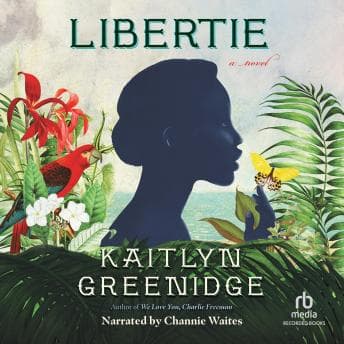

I've been teaching Reconstruction-era literature for two decades, and I thought I knew the territory. The familiar names, the expected narratives, the way we package that complicated period into digestible units for teenagers who'd rather be anywhere else. Then Channie Waites started reading Kaitlyn Greenidge's opening paragraph about magic and mothers, and I realized I'd been grading papers with the wrong lens entirely.
Listened to this one during a week of parent-teacher conferences—those marathon sessions where you smile until your face hurts and explain for the fortieth time why their child's C+ is actually an achievement. Libertie's struggle against her mother's expectations hit different when you're watching parents project their own unfulfilled dreams onto fifteen-year-olds.
The Weight of a Mother's Gaze
Greenidge does something I rarely see executed this well: she makes you understand both sides of an impossible relationship without letting either off the hook. Libertie's mother, a physician who can pass for white, has built a life of purpose and service. She's saved lives. She's earned respect. And she absolutely cannot see her daughter as anything other than an extension of her own mission.
Libertie, meanwhile, is drawn to music—to singing with her friends Experience and Louisa—and feels the suffocation of being loved too specifically. Her skin is too dark to pass. Her interests are too frivolous to matter. Her very existence is a project her mother intends to complete.
This reminds me of what Hemingway said about the iceberg—what's unsaid carrying the weight. Anna Karenina does something similar with its mother-daughter dynamics, though Tolstoy takes about three times as long to get there. Greenidge trusts her readers to feel the tension in silences, in the moments when Libertie watches her mother work and knows she'll never want this life but can't articulate why.
Waites Walks a Tightrope
Here's where I have to be honest. Channie Waites gives an emotionally rich performance that genuinely enhanced my experience—the loneliness, the yearning, the quiet fury all come through. When she voices Libertie's internal struggle, you feel the isolation in your chest.
But.
The early sections, where Libertie is young, feature an attempt at a childlike voice that... look, I've listened to hundreds of audiobooks. I understand the impulse. You want to differentiate. You want to signal youth. But there's a line between evoking childhood and making your listeners wince, and Waites occasionally crosses it. By the time Libertie grows into adulthood, the performance settles into something quite beautiful. Those first few hours, though? I found myself grading papers more aggressively than usual.
Waites understands that pause is punctuation—she uses silence brilliantly during the Haiti sections, when Libertie discovers that her husband's promises of equality were, shall we say, optimistic. The betrayal lands harder because she doesn't rush it.
Haiti and the Lie of Elsewhere
My students would hate this part. They want resolution. They want the protagonist to find her freedom, preferably with a montage and swelling music.
Greenidge refuses. Libertie accepts a proposal from a Haitian man who promises she'll be his equal on the island—a place where her dark skin won't mark her as lesser. And for a moment, you believe it too. You want to believe it.
Then you watch her discover that patriarchy doesn't respect geography. That escaping one cage doesn't mean you're free. That the men who promise equality often mean "equal to what I think you should be."
The prose deserves to be savored here. Greenidge writes Libertie's disillusionment with such precision—not as a sudden revelation but as a slow, grinding realization. Cutting Season explores similar territory—how the past refuses to stay buried in the South—with that same careful attention to historical weight. The audiobook flew by during these sections, which is saying something for a twelve-hour listen.
Who This Is For (And Who Should Skip)
If you loved Toni Morrison's exploration of Black womanhood, if you've ever felt the particular weight of being loved by someone who doesn't actually see you, if you're interested in Reconstruction beyond the textbook version—this is your book. Skip it if you need a fast-moving plot. This is character-driven literary fiction that takes its time. And if child voices in audiobooks make you want to throw your phone into Lake Michigan (speaking from experience), maybe start at chapter four and work backward later.
Worth Pausing the Faculty Meeting For
Libertie asks a question I've been turning over since I finished: What does freedom actually mean when every space you enter has already decided what you should be? Greenidge doesn't answer it—she's too smart for that. But she makes you sit with the question until it becomes uncomfortable.
The audiobook experience is imperfect. Waites' early-chapter choices will grate on some listeners. But when the performance works—and it mostly does—it transforms Greenidge's already lyrical prose into something that stays with you.
Principal Martinez, if you're reading this, I was definitely paying attention during last Tuesday's budget meeting. (I wasn't. I was in Haiti with Libertie, watching her dreams curdle into something sadder and truer.)