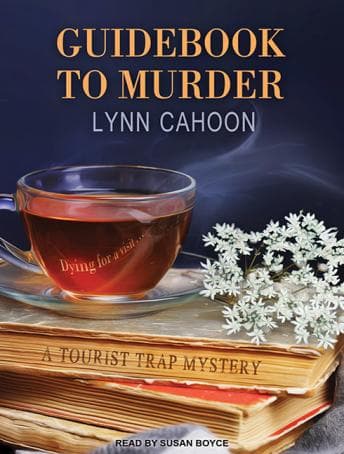

Look, I need to talk about character motivation for a second, because Jill Gardner's decision-making in Guidebook to Murder had me arguing with my cutting board while I was dicing onions for chana masala at ten o'clock on a Tuesday night.
Here's my complaint: Jill inherits a house from her dead elderly friend Miss Emily, and within approximately zero seconds she's decided Miss Emily was murdered and she's going to solve it herself. The protagonist exhibits classic amateur sleuth syndrome — that cozy mystery thing where a bookshop owner with no investigative training just... decides she's going to crack the case. And I get it, that's the genre. I signed up for this. But the why behind Jill's obsession never quite lands for me psychologically. Is it grief? Guilt? A need for control after loss? Lynn Cahoon gestures toward these things but doesn't commit to any of them, and that kept me at arm's length from a character I wanted to root for.
That said — and I'm being honest here — the setup is genuinely clever. The city council pressuring an elderly woman to sell her crumbling house, the real estate politics of a small coastal town, the way property and legacy become motives for murder. That's real human behavior. People absolutely kill over property disputes. The research actually shows that financial conflicts are among the top triggers for violence in close communities. So the bones of this mystery? Solid. The same vein of property-and-community-as-motive runs through Enemy, though that one commits harder to the psychological unraveling beneath the surface.
When the Coffee Shop Psychology Works (and When It Doesn't)
What makes this book interesting as a case study is the small-town ecosystem Cahoon builds. South Cove, California operates like a closed system — everybody knows everybody, alliances shift based on who's on the city council, and Jill's coffee shop (Coffee, Books, and More, which is a name my mother would love) becomes this nexus point for gossip and information. Cahoon clearly understands how small communities function as pressure cookers. The suspect list growing longer than the house's repair list? That's a nice structural parallel.
But Jill herself is where I kept getting stuck. Her romantic interest in Detective Greg King feels grafted onto the mystery rather than emerging from it. She's drawn to him because... he's attractive and present? Creation in Death is an interesting counterpoint here — that series does the work of showing exactly why a fiercely independent protagonist keeps circling back to the person who challenges her authority, and it earns the dynamic. I found myself asking: why does Jill really pursue this man who is actively telling her to stop investigating? Is it defiance? Attraction to authority she can challenge? The book doesn't seem interested in these questions, which is frustrating because they're the interesting ones.
The ending apparently lands abruptly for a lot of listeners, and I'd agree — it wraps up faster than you'd expect for an 8-hour investment. It's a first-in-series setup book, so some of that is structural, but it left me feeling like the last twenty minutes were on fast-forward.
Susan Boyce: The Narrator Problem Nobody Agrees On
Okay, so the narration situation is genuinely polarizing and I want to be fair about it. Susan Boyce has moments where she nails the cozy mystery tone — there's a dry humor in some of Jill's observations that Boyce delivers with just enough comedic timing to make you smile. But there's also this persistent flatness that creeps in during emotional scenes, and it undercuts the stakes. When Jill is supposedly frightened or grieving, Boyce's delivery stays at roughly the same register she uses for Jill ordering coffee.
The pronoun slips are real and they're distracting. When the narration suddenly switches from first person to third — "Greg looked at her" instead of "Greg looked at me" — it yanks you right out of the story. It happened enough that I noticed a pattern, which means it happened too often. Psychologically, this doesn't track as intentional; it reads as editing slips that should've been caught in production.
Some listeners describe Boyce's performance as "robotic," and while I wouldn't go quite that far, I understand the critique. It's more like she's reading to you rather than performing for you. For a cozy mystery where character warmth is basically the whole selling point, that gap matters.
Who Gets the Most Out of This (and Who Won't)
If you're already a cozy mystery devotee — the kind of person who has strong opinions about cats in mysteries and whether the protagonist should bake or brew — this is a perfectly serviceable entry point to what's apparently a long-running series. It's light, it's breezy, it won't keep you up at night with existential dread. Good for housework, good for a lazy weekend.
But if you need your amateur sleuths to have psychologically coherent motivations for risking their lives? If character development is your currency? You might find yourself, like me, enjoying the setting while wishing the people in it had more interior life. My therapist would have thoughts about Jill's avoidance patterns, but the book isn't interested in going there.
The Case File Stays Open
A decent cozy mystery with a strong small-town premise that doesn't quite deliver on character depth. I'll probably try the next one — sometimes series protagonists need a book or two to become fully realized people. But the narration issues are real enough that I'd suggest sampling before committing a credit. Pour yourself some coffee, keep expectations calibrated, and you'll be fine.