
"Do you want the honest truth? Most people don't."
I don't remember the exact timestamp - somewhere around hour three, deep into the push toward Baghdad - but that line stopped me cold. I was sitting in my truck outside a client's office in Round Rock, engine off, windows down in the Texas heat, and I just sat there for a minute. Because that's the whole damn book in one sentence. Evan Wright gives you the honest truth, and most people aren't ready for it.
The War I Recognize
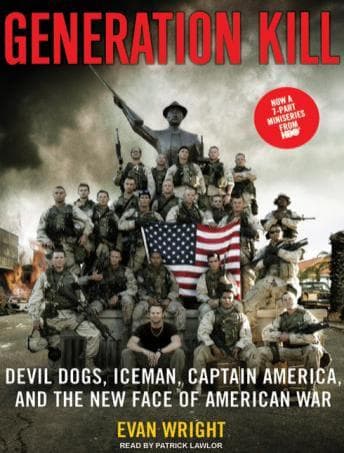
Let me cut to the chase: Generation Kill is the most accurate depiction of the Iraq invasion I've encountered in any medium. And I don't say that lightly. I was there - different unit, different AO, but the same war. I've read a lot of military history trying to process what that era meant — Armor and Blood: The Battle of Kursk is solid on the operational level but stays at 30,000 feet in a way Wright never does. Wright embedded with First Recon Battalion, and what he captured isn't the sanitized, flag-draped version you get from cable news retrospectives. It's the boredom punctuated by sheer terror. The absurd radio chatter. The way a platoon sergeant can be discussing Avril Lavigne one minute and calling in a fire mission the next.
The author clearly did their homework - or more accurately, he lived it alongside these guys and then had the discipline to write it down without Hollywood polish. The way he describes the ROE confusion at checkpoints, where Marines are simultaneously told to be aggressive and to avoid civilian casualties with zero useful guidance on how to do both? I've seen this scenario play out in real life. The frustration Wright captures when Bravo Two gets contradictory orders from Captain America (and yes, that's what they actually called their incompetent commander) - that's not literary embellishment. That's Tuesday in a combat zone.
What separates this from a hundred other Iraq War books is Wright's refusal to make anyone purely heroic or purely villainous. Sergeant Brad "Iceman" Colbert is probably the closest thing to a protagonist, and Wright portrays him as genuinely competent and deeply conflicted - a guy who keeps a running mental tally of every civilian near-miss. But Wright also doesn't flinch from showing Marines making terrible calls, leadership failing spectacularly, and the moral injury that accumulates like dust on a HMMWV windshield.
Patrick Lawlor and the F-Bomb Problem
Now, the narration. Patrick Lawlor had a nearly impossible task here. This book has roughly forty named Marines, each with distinct personalities, regional accents, and speech patterns - and approximately 40% of their dialogue consists of creative profanity. Lawlor handles it well. His pacing matches the book's rhythm: languid during the waiting-around stretches, clipped and urgent when rounds start flying. He doesn't try to do full theatrical voices for every character, which is the right call - this isn't fiction, and over-performing would've felt disrespectful to real people.
Where Lawlor really earns his paycheck is in the tonal shifts. Wright's writing swings from laugh-out-loud Marine humor (the running gag about Trombley wanting to shoot everything that moves) to genuinely disturbing civilian casualty descriptions, sometimes within the same paragraph. Lawlor navigates those transitions without telegraphing them, which keeps you off-balance. That's how it should feel.
One note: the profanity thing. Yeah, there's a lot. If you're listening at your desk or around kids, headphones are mandatory. But if the language bothers you on principle, you're probably not the audience for a book about a reconnaissance battalion in active combat. These guys talked like Marines. Wright wrote it down. Lawlor reads it as written. That's called integrity.
Where the HBO Series Can't Follow
If you've seen the HBO miniseries - and it's excellent - the audiobook gives you something the show can't: Wright's internal processing. His growing understanding of what he's watching, his own fear during ambushes (he's a Rolling Stone journalist sitting in the back of an unarmored Humvee), and his real-time reckoning with the gap between strategic objectives and ground-level reality. The show dramatizes events. The book lets you sit inside the confusion.
At 13 and a half hours, it's a commitment. But so was the invasion. The pacing earns its runtime - Wright structures the narrative chronologically along the battalion's push north, so you feel the accumulating exhaustion right alongside First Recon. I listened at my usual 1.25x and it tracked perfectly. Lawlor's delivery is clean enough that the speed bump doesn't cost you anything.
Who Needs This in Their Ears
If you served post-9/11, this is required listening. Period. If you didn't serve but want to understand what that generation of warriors actually experienced - not the bumper-sticker version - this is your entry point. If bad military details in books drive you crazy (and they should), Wright will not let you down. He knows the difference between a magazine and a clip, between a battalion and a brigade, and he respects the details because he respects the men.
Skip this if you want a neat moral arc or a clean resolution. War doesn't provide those, and Wright is honest enough not to manufacture them.
Ranger approved this one. So do I.
Mission accomplished.





![Steve Jobs [unabridged audiobook] audiobook cover](/_next/image?url=https%3A%2F%2Fcovers.audiobooks.com%2Fimages%2Fcovers%2Ffull%2F9788499923406.jpg&w=1920&q=75)