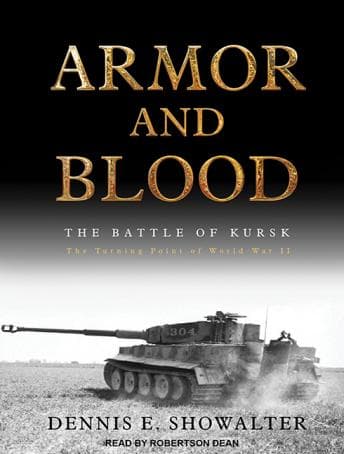

Let me cut to the chase: I've read more Eastern Front histories than I care to admit, and most of them treat Kursk like a footnote between Stalingrad and Berlin. Showalter doesn't make that mistake. He gives this battle the weight it deserves - three million men, eight thousand tanks, the largest armored engagement in human history. And yet.
And yet I almost threw my phone across the room during hour three.
The Detail Problem Nobody Warns You About
Here's the thing about military history audiobooks - there's a sweet spot between "too shallow" and "I'm drowning in unit designations." Showalter lands firmly in drowning territory. He'll be tracking the 2nd SS Panzer Division's advance, then suddenly we're three layers deep into Soviet defensive doctrine, then we're discussing the metallurgical differences between T-34 and Tiger armor plating. My brain was doing tactical map overlays while driving I-35, and that's not safe for anyone.
The timeline becomes genuinely hard to follow. I found myself rewinding sections multiple times - not because they were complex in an interesting way, but because Showalter jumps between strategic overview and granular tactical detail without clear transitions. For an audiobook, this is a real problem. On paper, you can flip back. In your truck at 6 AM heading to a client site? You're just lost.
Where Showalter Actually Delivers
Now here's where I stop complaining. The man clearly did his homework. He's pulled from the Russian military archives that opened after the Cold War, and you can feel the difference. This isn't the sanitized Western version where the Soviets just threw bodies at German positions until something broke. Showalter shows the actual operational art - the Soviet deep battle doctrine, the deliberate defense-in-depth that turned Kursk into a meat grinder by design.
His treatment of tank warfare is where the book genuinely shines. He gets into what happens inside those steel coffins - the heat, the noise, the way crews would fight for hours knowing that any penetrating hit meant fire and death. I've seen what modern armor can do to the human body. Reading about the same physics with 1943 technology, with crews who knew the odds... that hit different.
The strategic analysis is solid too. Both Hitler and Stalin micromanaging their generals, both sides knowing this was the decisive moment, both committing everything. Showalter captures that mutual recognition - this wasn't a battle of maneuver, it was a deliberate collision.
Robertson Dean: Mission Adequate
Let's talk about the narrator. Robertson Dean is... fine. Clear pronunciation, professional delivery, gets through the Russian and German names without stumbling. But here's the problem: he reads a ten-hour military history the same way you'd read a corporate earnings report. Flat. Monotonic. When you're describing Prokhorovka - tanks literally ramming each other because they couldn't maneuver - I need some energy in the voice.
There's no character differentiation to speak of, but honestly, this isn't a character-driven book. Showalter isn't giving us dialogue-heavy scenes. It's analysis and narrative, and Dean handles that competently. I just wish he'd found another gear for the actual combat sequences. Some emotion. Something.
I bumped the speed to 1.25x and it helped. Made the pacing feel more urgent, which matched the material better than Dean's natural tempo.
Who Should Listen (And Who Should Skip)
If you're a serious student of World War II - especially the Eastern Front - this is essential reading. Showalter synthesizes the newer Russian sources better than anyone else I've encountered. If you want to understand why Kursk mattered, why it broke the Wehrmacht's offensive capability permanently, this is your book.
But if you're looking for narrative-driven history, something like Beevor or Hastings, you'll find this dry. It's academic in the best and worst senses. For something with more narrative drive, Vikings: A History strikes a better balance between scholarship and storytelling. Ranger fell asleep during hour five, and I can't entirely blame him.
Skip this one if you need background listening or want your history served with dramatic flair. You'll miss critical context and spend the rest of the book confused about which army group is where.
SITREP
Worth your time? For the right listener, absolutely. Showalter has produced what's probably the definitive English-language account of Kursk. The research is impeccable, the analysis is sophisticated, and he treats both the German and Soviet perspectives with appropriate complexity.
But the audiobook format fights against the material. Dense academic prose plus monotonic narration plus no visual aids equals a challenging listen. I'd almost recommend reading the physical book instead - you'll want to reference the maps anyway.
For the dedicated military history crowd, this is worth a credit. For everyone else, maybe wait for a sale and see if it's your thing. Ranger gives it a sleepy paw of approval.







![Steve Jobs [unabridged audiobook] audiobook cover](/_next/image?url=https%3A%2F%2Fcovers.audiobooks.com%2Fimages%2Fcovers%2Ffull%2F9788499923406.jpg&w=1920&q=75)