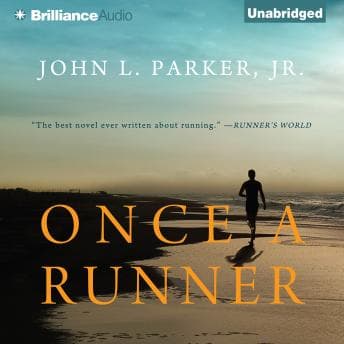

I'll admit it—I was one of those literary snobs who dismissed sports novels as genre fiction for people who couldn't handle real prose. Then I spent eight and a half hours with Quenton Cassidy on the lakefront path, and now I owe an apology to every runner who ever tried to press this book into my hands.
The thing about Once a Runner that nobody warns you about is how much it reads like a monastic text. Not in the boring way. In the way that makes you understand why medieval monks copied manuscripts by candlelight. Parker writes about running the way Hemingway wrote about bullfighting—as if the physical act contains some essential truth about being human that can't be accessed any other way. My students would hate this. I love it.
The Prose Deserves to Be Savored (Even When the Narrator Doesn't)
Let me be honest about Patrick Lawlor's narration, because the reviews are all over the place and I think I understand why. His voice has this... quality. Some listeners call it whiney. I'd call it relentless. For the first hour, maybe hour and a half, I kept thinking I'd made a mistake. The main characters—Cassidy and his mentor Bruce Denton—sound almost identical. When you're trying to track dialogue between two runners discussing interval training philosophy, that similarity can blur things together.
But here's what happened. Somewhere around hour three, walking past the Shedd Aquarium at sunset, I realized the sameness was working. These men are cut from the same cloth. They speak the same language—literally, the language of split times and lactate thresholds and that particular kind of suffering only distance runners understand. Lawlor's choice (intentional or not) to keep them tonally similar actually reinforces the mentor-disciple relationship. The one exception that proves the rule: when a football coach appears, Lawlor drops into this gravelly Southern drawl that's so distinct it's almost jarring. The contrast reminds you that Cassidy exists in a world that doesn't understand him.
What Hemingway Would Say About the Four-Minute Mile
Hemingway said the dignity of movement of an iceberg is due to only one-eighth of it being above water. Parker gives you the surface: training logs, interval workouts, the politics of a university athletic department during Vietnam. But underneath is something else entirely. Cassidy's pursuit of the four-minute mile becomes a meditation on what it means to want something so badly you'll sacrifice everything—scholarship, girlfriend, future—to stand on the starting line.
The book drags in the first third. I won't pretend otherwise. There's setup about the protest that gets Cassidy suspended, administrative politics, the kind of institutional detail that feels important but doesn't exactly fly by. I found myself speeding up my walking pace just to match the narrative's rhythm, hoping it would pick up. It does. When Cassidy retreats to his "monastic" training camp with Denton, the book transforms. The training sequences are almost hypnotic—Lawlor finds his groove here, creating forward momentum that mirrors the endless repetition of miles.
The Sacred Text Problem
Here's my confession: I've never run more than a reluctant mile in my life. Bad knees, worse attitude. So I came to this as an outsider to running culture, which apparently treats this novel like we English teachers treat The Great Gatsby—a foundational text, passed down like scripture. (The author literally sold copies from his car trunk at road races in 1978. That's commitment.)
What surprised me is how much the book works even if you've never experienced runner's high. Parker writes about obsession, about choosing one thing and pursuing it past the point of reason. I know that feeling from different contexts—the year I spent on my dissertation, the way I still chase the perfect lesson plan at 11 PM when I should be sleeping. That same obsessive energy, though channeled into something completely different, drives the protagonist in I Found You: A Novel. The specificity of running becomes universal. When Cassidy talks about the loneliness of training, about how nobody can do the work for you, I thought about every student I've watched struggle with Faulkner, trying to explain that the difficulty is the point.
Who This Book Is (and Isn't) For
Some content notes: there are moments of casual sexism that feel very 1970s collegiate athletics. Cassidy's girlfriend exists mostly as something he sacrifices for his goal. If you're looking for dimensional female characters, look elsewhere. The book knows what it is—an insider's account of a particular masculine subculture at a particular moment in time.
Runners, obviously—this is your origin story. But also anyone who's ever been consumed by a single goal. Anyone who's felt like an outsider in their own institution. Anyone who wants to understand why people do hard things when easier options exist. Skip it if you need plot to move quickly (the first few hours will test you), if similar character voices drive you crazy, or if you want a balanced portrayal of college life in the Vietnam era. This is laser-focused on one man's obsession.
Class Dismissed
I listened at 1.0x because the author chose those words. Parker's prose has a rhythm that matches footfall on pavement. Speed it up and you lose something essential. This is why we still read the classics—or in this case, the cult classics that became classics through sheer persistence, passed from runner to runner like a baton in a relay.
Denise asked me why I kept walking an extra mile past our usual turnaround point. I told her I needed to finish a chapter. Really, I just wasn't ready to leave Cassidy alone on that track.