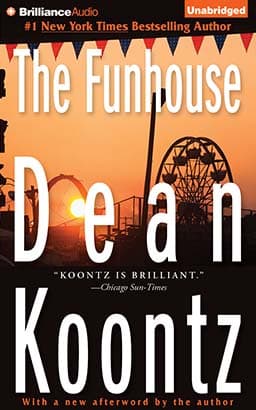

What happens when a horror legend writes a novelization of his own screenplay before the movie even tanks at the box office?
You get Funhouse — a weird little artifact from early-career Dean Koontz that reads less like a polished novel and more like a fever dream someone had after eating carnival corn dogs at midnight. I pulled this one up on a rainy Saturday while reorganizing the horror section at the branch library (yes, I was on the clock, and no, I don't feel bad about it). Eight hours and fifteen minutes later, I had thoughts.
The Carnival Came Back — But Did It Bring Enough?
Here's the thing about carnival horror: it should be the easiest layup in the genre. You've got the rickety rides, the freakshow underbelly, the lights that look warm from a distance but sinister up close. Koontz knows this. The atmosphere in Funhouse is genuinely unsettling when he commits to it — the traveling carnival rolling back into town like a bad omen, the funhouse itself operating as this grimy, claustrophobic nightmare space. There's a sequence where the carnival's darker secrets start bleeding through the surface-level spectacle that gave me real Something Wicked This Way Comes energy, just... dirtier. Meaner.
Speaking of carnivals that mean business, Koontz's own Twilight Eyes does this exact thing with more psychological weight — hold that thought, we'll get there.But the novel has this structural problem I can't ignore. It opens twenty-five years in the past with Ellen's first marriage, her monstrous birth, her infanticide — and that section is genuinely harrowing. Then we jump forward to present-day Ellen drowning in booze and guilt while her teenage daughter Amy navigates a pregnancy and a returning carnival. The two halves don't quite talk to each other the way they should. It's disjointed. The past timeline crackles with dread; the present timeline keeps stalling out with characters who feel like they're waiting for the plot to tell them what to do. Joey, the monster-movie-obsessed kid? He should be the heart of this book. Instead he's mostly just... there. And Amy's friends are sketched so thinly they might as well be carnival cutouts.
This is early Koontz working from screenplay bones, and you can feel it. Scenes are structured for visual payoff rather than psychological depth. Which, fine — but in audio, where you're trapped in someone's head for eight hours, that thinness starts to show.
Karen Peakes Does the Heavy Lifting
Karen Peakes is solid here. Not revelatory, but solid — and with material this uneven, solid counts for a lot. She handles Ellen's guilt-soaked internal monologue with a kind of weary desperation that sells the character even when the prose doesn't fully earn it. I've heard her lean into that same quiet dread in A Thin Dark Line, where she basically carries the whole eight-hour runtime on her back. Her shift between the flashback sections and the present day is subtle but effective; younger Ellen sounds rawer, more panicked, while present-day Ellen has this flattened, medicated quality that tells you everything about twenty-five years of suppressed horror.
Where Peakes struggles a bit is with the male characters. The carnival barker husband, the teenage boys — they tend to blur together in tone. It's not a dealbreaker, but in a book where the men are already underwritten, having them sound interchangeable doesn't help. She's strongest when the material goes dark. The birth scene. The funhouse climax. When the story demands visceral commitment, she commits. That's rare.
I just wish she had more to work with in the middle stretch, where the pacing sags and we're spending time with characters who exist to be threatened rather than to be people.
Shirley Jackson Walked So — Actually, Let's Not Go There
Look, I can't pretend this is top-shelf Koontz. It's not Intensity. It's not even Twilight Eyes, which does the carnival horror thing with way more psychological heft. Honestly, if you want a Koontz novel that actually coheres while staying gloriously pulpy, Frankenstein: City of Night is what this should've been. Funhouse is a fun, trashy, occasionally genuinely creepy B-movie of a book — and I mean that with affection. The problem is that at eight-plus hours, you need more than atmosphere and a wild premise. You need characters you can invest in, and this book keeps its characters at arm's length.
That said? The carnival atmosphere is the real draw. If you're the type who listens to horror in October just to set a mood — and I know you are, because you're reading this review — there are worse ways to spend a Saturday. The funhouse sequences deliver. Ellen's backstory delivers. The connective tissue between those high points? That's where you might find your attention wandering.
So who's this for? Halloween mood listeners. Koontz completists. People who liked the idea of the 1981 movie but wanted something with more teeth. Skip it if you need strong character work to stay engaged, or if disjointed structure drives you nuts.
File It Under: Guilty Pleasure, Emphasis on Both Words
My podcast listeners are going to have opinions about this one. I can already hear the emails. Funhouse is a messy, atmospheric, occasionally brilliant piece of early Koontz that doesn't quite hold together as a novel but absolutely works as a vibe. Karen Peakes keeps it listenable even through the rough patches. I listened in the dark. Mistake? Maybe. Worth it? The funhouse scenes, absolutely. The rest? I'd have been fine with the lights on. Shirley (my cat) was unimpressed. I was somewhere in between.