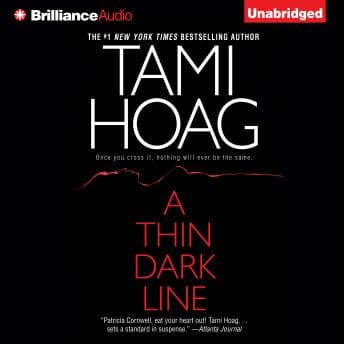

People keep telling me Tami Hoag is "just" a thriller writer. Like that's a genre you can sleepwalk through. I've seen her name shelved between romance and crime at my library for years, and I'll admit - I came to A Thin Dark Line with some skepticism. Bayou setting, cop-on-the-edge, suspected murderer walking free? Sure, I've heard that pitch before. But somewhere around hour three, sitting on my apartment floor with Shirley curled against my ankle and the rain doing that thing Oregon rain does where it just commits to being miserable, I realized this book had gotten under my skin in a way I wasn't expecting.
The Bayou Gets Inside Your Head Whether You Want It To
Hoag understands something a lot of thriller writers don't: the setting isn't wallpaper. Bayou Breaux isn't just humid backdrop for murder — it's claustrophobic, insular, the kind of place where everyone knows your business and nobody knows the truth. The town dynamics here feel genuinely suffocating. Nick Fourcade is the detective who crossed the line — planted evidence, or maybe didn't, depending on who you believe — and the way Hoag writes him, you're never fully comfortable rooting for him. That's the trick. She keeps you off-balance. Annie Broussard is the deputy who found the body, and her arc is where the real tension lives: she's trapped between wanting justice and knowing that aligning with Fourcade could torch her career in a department that already doesn't take her seriously.
This understands that horror isn't about gore — it's about dread. And yeah, I'm calling this horror-adjacent, fight me. The phantom echoes Annie hears? The mutilation she can't unsee? Hoag writes psychological damage the way it actually works — not as a dramatic monologue, but as intrusive flashes that hijack ordinary moments. The romance subplot runs underneath everything, and honestly, it works better than it has any right to. Hoag's roots in romance fiction show here, but not in a way that softens the story. If anything, it makes the vulnerability sharper. These are two damaged people circling each other in a pressure cooker, and you feel every degree of that heat. Big Little Lies does something similar — wraps a genuinely dark story about power and damage inside a structure that feels almost domestic, until it doesn't.
Karen Peakes Knows What She's Doing
The narrator commits. That's rare. Karen Peakes handles Annie's voice with this steady, determined quality that cracks at exactly the right moments — when Annie's alone, when she's processing what she saw, when she's pretending she's fine to colleagues who don't care either way. Her Nick Fourcade has this low-simmering intensity that never tips into cartoonish tough-guy territory, which is a real risk with a character this volatile. The male voices are convincing enough that I stopped tracking who was speaking and just... listened. That's when you know a narrator has you.
At eighteen hours, this is a commitment. And I won't pretend every minute earns its runtime. The middle section — the procedural stuff, the political maneuvering within the department — drags in spots. Not badly, but enough that I bumped to 1.25x for about two hours before pulling back when the tension ramped up again. Peakes keeps the slower sections listenable through sheer vocal investment, but the pacing is the book's weakness, not hers.
Where the Line Actually Is
What kept me locked in — and what I think Hoag does better than most writers in this lane — is the moral ambiguity. Nick isn't a hero. He might be right about the killer, but his methods are genuinely disturbing. Annie isn't naive, but she's compromising herself inch by inch and she knows it. The killer, when you finally understand the full picture, isn't a monster in the way you expect. Hoag refuses to let you settle into comfortable categories. The "thin dark line" isn't just about law enforcement ethics — it's about how far you'll go when you believe you're right, and how that belief starts looking identical to obsession if you squint.
I listened to the last four hours in one sitting, lights off, headphones in. Mistake? Maybe. Worth it? Absolutely. The final stretch earns every minute of the slower buildup.
Who Needs This in Their Ears
If you want something fast and disposable, this isn't it. At eighteen hours, Hoag is asking for your patience, and she mostly rewards it. If you scare easily, skip — not because there are jump scares, but because the psychological violence here sits with you. If you love character-driven crime fiction where nobody's clean and the bayou feels like a character with its own agenda, this is your book. My podcast listeners who love procedurals with actual moral weight are going to eat this up. Close to Home belongs in that same conversation — a thriller that trusts its readers enough to sit in the uncomfortable questions rather than rush toward resolution.
Shelving this one next to my Lehane and my French. It earned its spot.